The first thing I bought after the machine was thread, and the first thing I got wrong was thread. I bought my Brother SE1900 in October 2023, a few months after I retired from the school office, and I started with a small handful of Brother-branded spools from the local shop. Those lasted about two weeks of practice towels. Then I sat down with a cup of coffee, opened the laptop, and ordered the New brothread 40 color kit in November 2023. Mostly because I was tired of stopping in the middle of a monogram to dig for a color I did not own.
Three years later, that same box sits on the rolling cart beside my folding table. I have replaced nothing and thrown nothing away. Everything I have made since, monograms on hand towels and bath towels, fleece baby blankets, canvas totes and cloth napkins, came off those spools or a later spool from that same box. Some of it went to my granddaughter Lily. Some of it went to friends and church people. A good deal of it went on a table at the St. Peter's holiday craft fair in December, twice now.
The Quick Verdict
Forty spools of 40 weight polyester, 500 meters each, that have held up through three years of hot washes and one craft fair a year. My only real complaint is that a few spools unwind on their own.
Amazon Check Today's Price →The thread box that has been on my cart since November 2023
Forty spools, 500 meters each, one printed chart. It is what I reach for every single time I hoop a towel. Check today's price and the current color chart on Amazon before you buy.
Amazon Check Today's Price on Amazon →How I've Used It
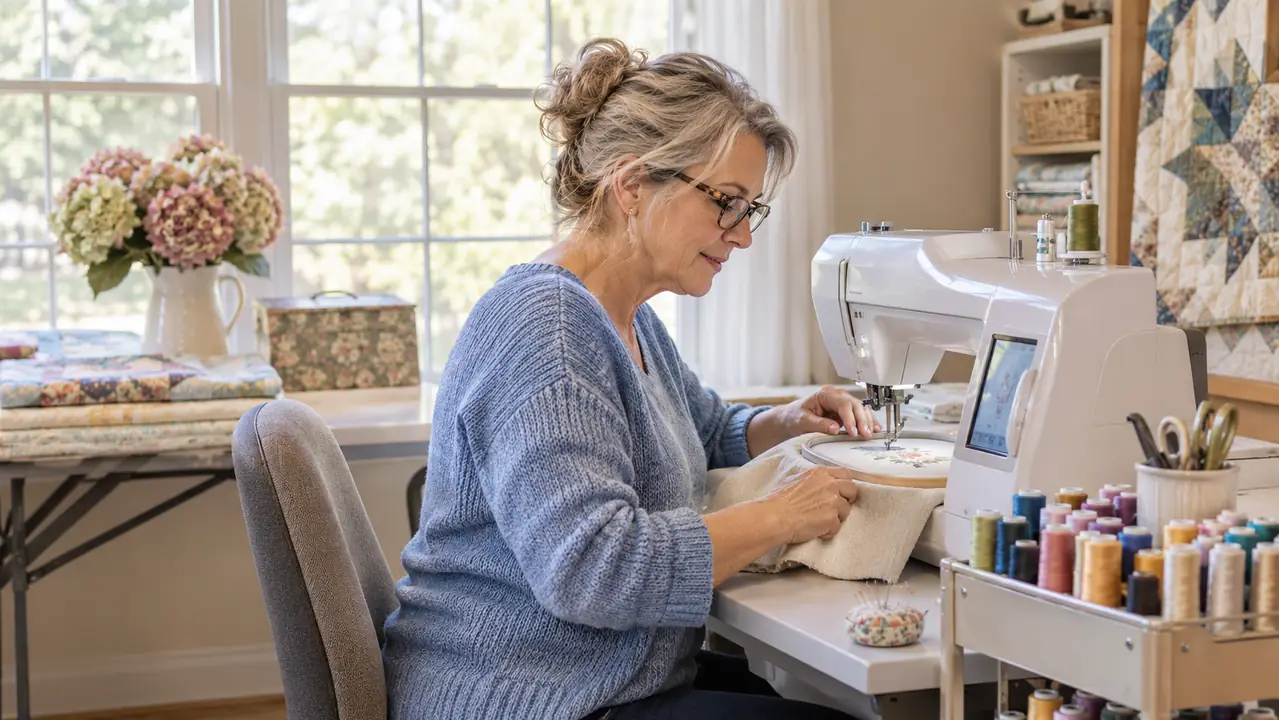
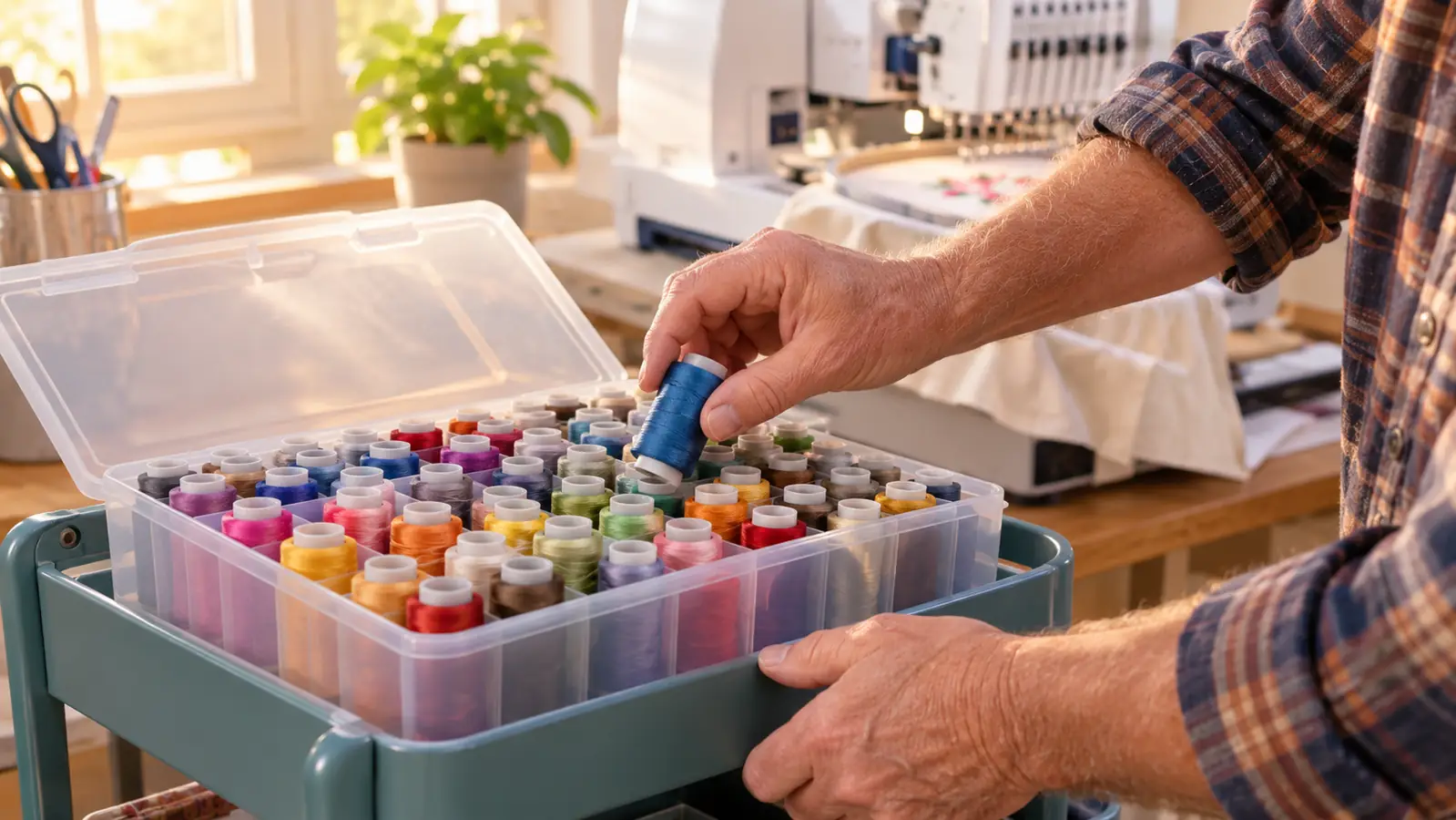
My setup is not fancy, and that matters for what follows. The machine sits on a six foot folding table pushed against the window in the upstairs spare bedroom, which used to be where the ironing board lived and nothing else. There is a corner shelf for blanks, one wall outlet strip, and a rolling cart within arm's reach. The kit lives on top of that cart inside its own storage box, sorted to the printed chart that came in the lid. I can put my hand on navy, white, gold or the soft pink I use for baby items without standing up.
Before the box arrived I did what I always do, which is over-prepare. I wiped down the top of the rolling cart, set the box there, and taped the printed chart inside the lid where I could read it from the chair. Then I pulled all forty spools out and put them back in chart order, because they ship roughly sorted and roughly is not the same as sorted. That took about twenty minutes on a Tuesday afternoon and I have never had to redo it. My hands know that box now. Navy lives in the left third. The soft pink sits on the right, beside the light blue, because those two always get used in the same week.
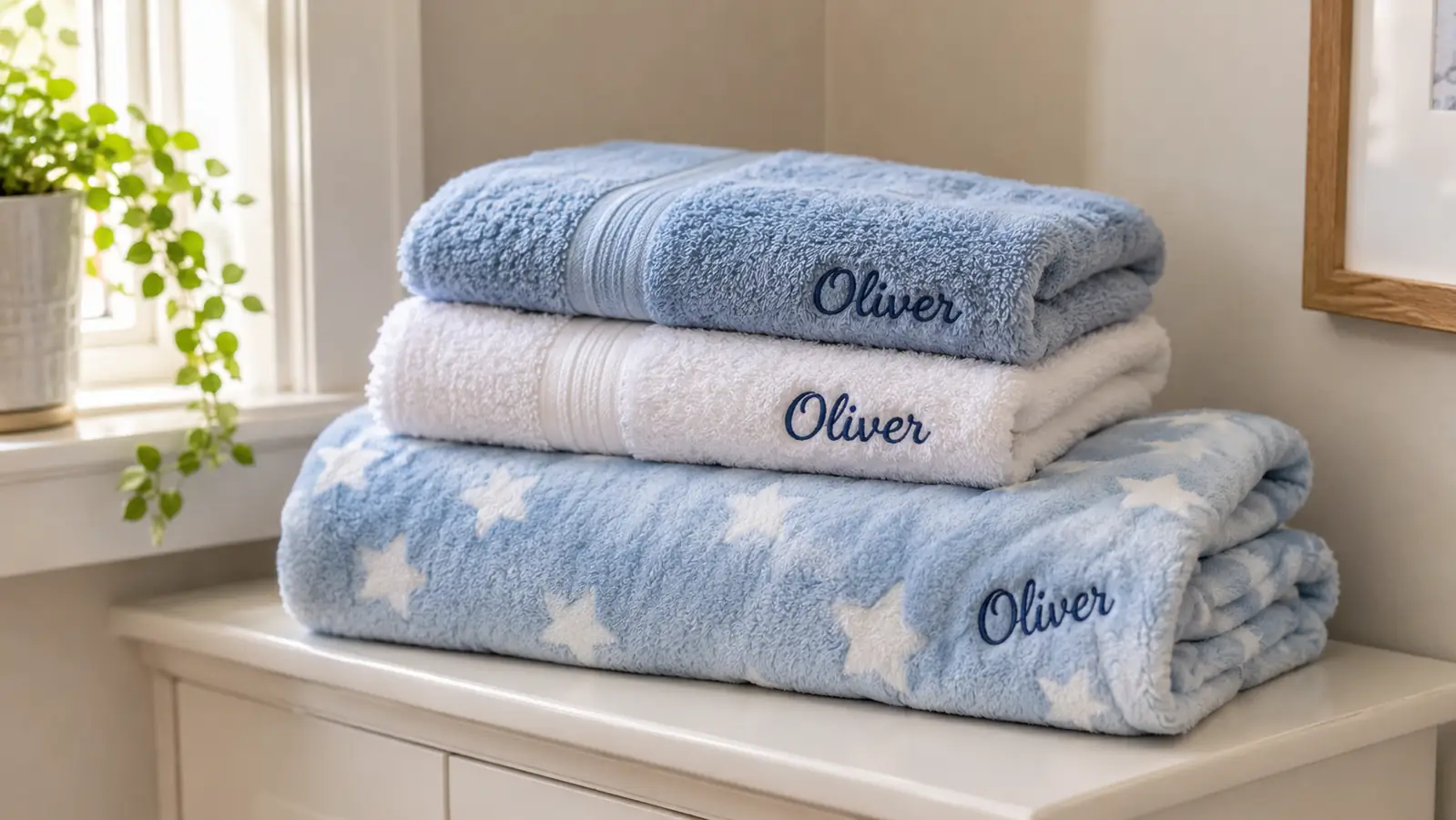
What I stitch is narrow on purpose. Names and monograms on hand towels and bath towels. Fleece baby blankets. Canvas tote bags. Cloth napkins. No caps, no jackets, no leather, nothing that needs a special hoop or a second machine. That narrow list matters, because it means I have never asked this thread to do anything exotic. I have asked it to hold a name on a towel through a hot wash and to still look right afterward. Three years of that is a fair test.
A word about what goes under the fabric, since it changes how the thread behaves. I use precut 10 by 12 tear away sheets, one under a hand towel, two doubled under a thick bath towel, plus a clear water-soluble topper on anything with a loop. One sheet of tear away is thin for a dense monogram on a thick towel, and I learned that the ordinary way, by watching a name pucker on a bath towel I had already stitched. The thread was never the problem that day. The support underneath it was.
A normal week is two or three small items, and more in November when the craft fair gets close. Over three years that is a great many spools started and very few finished. The first spool I used all the way to the bottom was white, and it took more than a year. The 500 meters on each spool goes a long way when your design is a name and a border.
Two other things in that room do the supporting work. I hoop with a plastic hoop set that has a 4 by 4 for hand towel monograms and a second 5 by 7 so I can load the next item while one is stitching. And I run plain white pre-wound bobbins from a generic box, not matching bobbins. That part is worth saying out loud. If you are waiting to buy forty matching bobbins before you start, do not. White bobbin thread has not once shown through on anything I have made, and I do not expect it to.
What 40 Spools Actually Changed in a Small Room
The obvious thing a kit changes is that you stop interrupting yourself. Before the kit, every project began with a small negotiation about which of six colors could pass for the one I actually wanted. My first practice towels were all the same pale shade because it was the only thing I owned enough of. The first gift I was genuinely proud of, a set of hand towels for my friend Carol's anniversary, is navy and white. It is navy and white because those were the two colors I had enough of, not because I sat down and chose them.
The second thing it changed is how fast I decide, and that one surprised me. Forty colors sounds like it would be paralyzing. It is not, because the chart sorts them and after a month you know exactly where your workhorses live. Mine are navy, white, a soft pink and a light blue for anything going to a baby, plus gold for anything that needs to look like an occasion. The other thirty-five are not wasted. They are the reason I can say yes when a neighbor asks for a name in a color that is not one of my five.
Here is the kind of thing I mean. In February my neighbor Denise texted about a baby blanket for her daughter's shower and asked, as politely as anyone has ever asked me anything, whether I had anything in a sage green. I did. I had never used that spool and I have used it twice since. That is not really a story about thread. It is a story about being able to say yes without a twenty minute drive each way to the shop, which is what my answer would have been three years ago. Denise would have gotten a white blanket with a navy name on it, and she would have been perfectly nice about it.
Three years in, I have never run out of a working color in the middle of a project. Not once. That is the entire benefit and it is a quiet one. It does not photograph well and nobody at the craft fair has ever asked me about it. It just means I finish what I start, and in a spare bedroom with one machine, finishing is most of the battle.
How It Behaves on Wash Day
Everything I make gets washed, because everything I make is either going to be used by someone or is going into my own kitchen and bathroom. Towels go through hot water with the regular load, no special treatment. The New brothread listing claims colorfastness through commercial laundering and bleaching. I can only tell you the half I have actually tested. The navy on Carol's towels still reads navy, the pink on Lily's blanket still reads pink, and I have never had a thread bleed onto the fabric around it. I do not bleach my own laundry, so I will not vouch for that part.
What I can vouch for is how the stitching looks after a year of washing. Polyester keeps a slight sheen. Cotton thread would have gone dull by now. Whether that sheen is good depends entirely on what you are making. On a bath towel it reads as deliberate, like a monogram you paid someone for. On a soft fleece baby blanket it is a touch dressier than the blanket itself. I have decided I like that. You should know it before you stitch a name on something you wanted to look plain.
My own test case is a white bath towel with a gold monogram I made for myself in early 2024, mostly because I wanted to see whether gold held. It goes into the towel load every week, same as everything else, no gentle cycle and no hanging it to dry. Two and a half years of that and the gold has not gone brassy, and it has not faded to a weak yellow either, which is what I half expected. I kept it in the rotation instead of moving it to the cupboard with the good ones, because a test you baby is not a test.
One practical note. Hot washes and a dryer are rough on any embroidery, so I turn towels inside out before they go in the machine if I remember. When I forget, nothing has come loose yet. I am telling you that so you know the thread is not the fragile part of this arrangement.
Three years in, I have never run out of a working color in the middle of a project. Not once. It just means I finish what I start.
The One Annoyance I Actually Have
A few spools in my kit let the thread slip off the top and puddle on the cart. Not most of them. Maybe four or five, and it has been the same four or five since the beginning. The first time it happened I assumed I had loaded the machine wrong and spent twenty minutes checking the thread path. I had not. The thread had simply come off the spool in a loose coil while I was doing something else.
My fix costs nothing and takes a second. A small thread net over the offending spool holds the coil where it belongs, and I have not thought about it since. That is the whole complaint. If a loose coil on five spools would bother you every time it happened, know it going in. If you keep a drawer of small fixes the way I do, you will have forgotten about it by the second month.
What I Can and Can't Tell You About Simthread
My friend Marjorie from church uses Simthread for the same kind of work, and she brought a set to the fellowship hall one Sunday so I could look at it. It is thread in a box, wound on spools, with a chart. I have not stitched with it. I have not washed anything made with it. I am not going to pretend otherwise, because a comparison written by someone who looked at a box once is not worth your time.
What I can tell you is why I stayed where I was. My kit was already on the cart, already sorted, already proven through three Decembers. Switching would have meant rebuilding a system that already works, for no reason I could name. Marjorie's set looked perfectly serviceable and I would not steer anybody away from it. That is as far as I will go.
What I Liked
- Forty colors and a printed chart, sorted once and never re-sorted
- 500 meters per spool at 40 weight, so one spool carries many small projects
- Polyester holds its color and its slight sheen through repeated hot washes
- One box holds the whole kit, which matters when your sewing space is a spare bedroom
- Enough range that you can say yes to a color request outside your usual five
Where It Falls Short
- A few spools unwind and puddle unless you put a net on them
- The polyester sheen is dressier than cotton, which is not always what a soft blanket wants
- Forty spools is more than a beginner can organize well in the first week
Who This Is For
This is for the home embroiderer with one machine, a table by a window, and a steady trickle of small projects. Grandmother gifts, church towels, a neighbor's baby blanket, one craft fair a year. If you are stitching names and monograms inside a five by seven inch field, this New brothread kit covers that comfortably and then some.
If you are brand new, one piece of advice from three years in. Do not open all forty spools on the first day. Pick five and work with those until threading the machine stops being something you think about. I spent my first two weeks on a stack of scrap towels practicing the letter A and a simple border, and I used white and navy for all of it. The rest of the box waited. Some of it is still waiting, and that is fine. Thread does not spoil and it does not go out of style because you did not get to it in the first month.
It is also a sensible first thread purchase for someone who just bought a machine. You do not yet know which colors you will reach for, and the honest answer is that it will not be the colors you would have picked. I would have bought six shades of blue. What I actually use is navy, white, pink, light blue and gold. Forty spools lets you be wrong about your own taste, which is worth more than it sounds.
Who Should Skip It
Skip it if you sell finished goods at real volume and have to reorder one exact shade over and over. That is a different kind of buying and I am not the person to advise you on it. Skip it if you only ever stitch one color, because you will be storing thirty-nine spools you never touch. And skip it if a loose coil on a spool would bother you every time it happened. I would rather you hear that from me now than find it out at ten at night with a towel half done.
Still the box I reach for, three years on
If your work is names and monograms on towels, blankets and totes, this is the New brothread kit I have used for all of it. Check today's price on Amazon and look over the current chart before you commit.
Amazon See the Current Kit on Amazon →