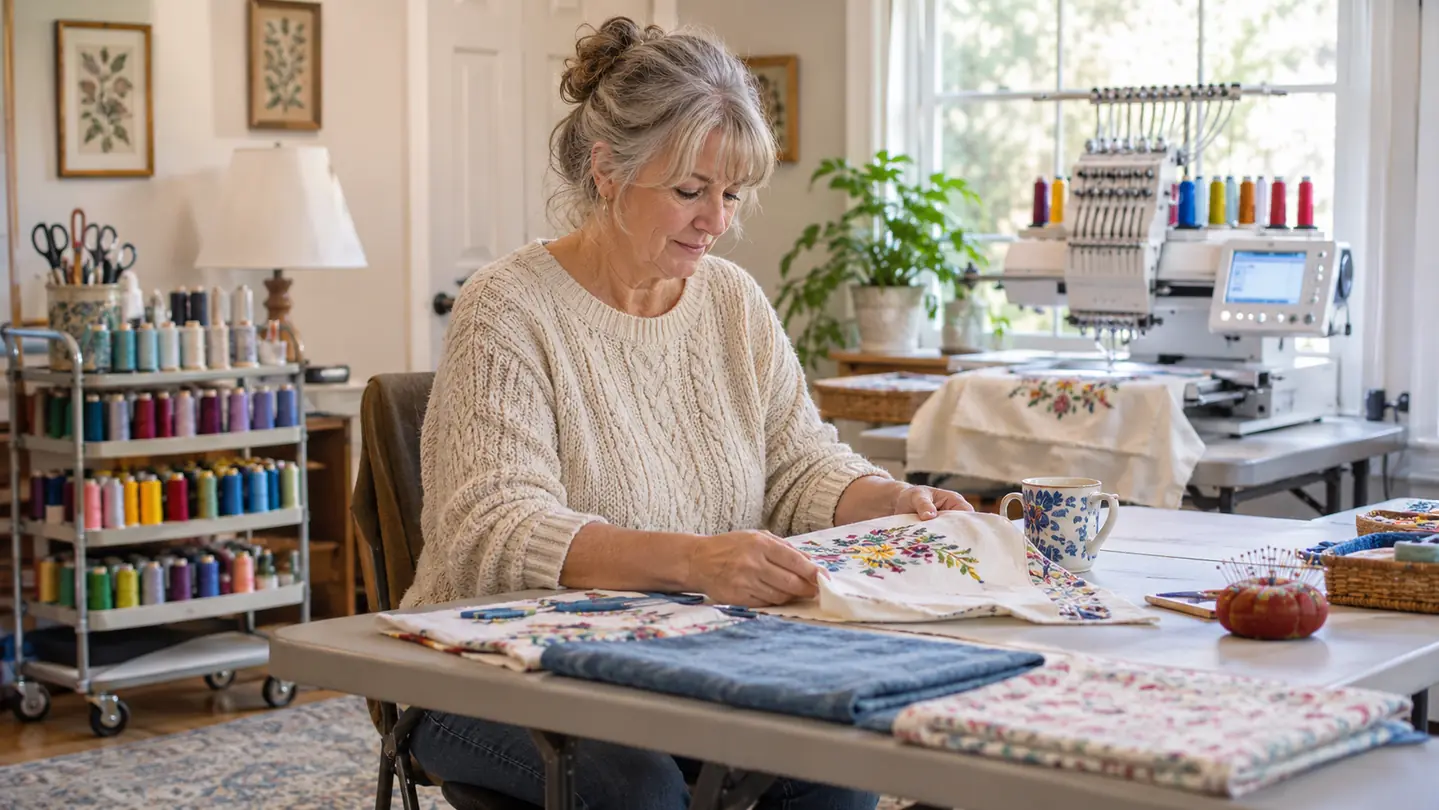
The first pack of HBI tear away stabilizer came home with my Brother SE1900 in October 2023, and I did not think about it again for months. The bag is printed HBI H.B.I. PRODUCTS, which is a lot of name for a stack of sheets, and I put it flat on the corner shelf and got on with learning the machine. I bought the SE1900 to make monograms for friends and church people, small orders and gifts, and stabilizer was the boring line on the receipt, the thing you buy so you can buy the thing you actually wanted. Three packs later I have an opinion about it. Not a dramatic one, but a real one, and it was formed in the spare bedroom upstairs with one six foot folding table, a rolling cart of thread, and a window that gives me good light until about two in the afternoon.
Here is the short version, and then the long one. This stabilizer does what a tear away is supposed to do at low to medium density, and it is precut, so there is nothing to measure, no rotary cutter to drag out, and no scraps drifting onto the carpet. It is also thin enough that a dense monogram on a thick bath towel wants two sheets. That is the one thing I would change, and it is also the thing I work around every week without much complaint. If you want the summary, the verdict block is right below. If you want to know how it behaves on towels, blankets, totes and napkins, keep reading.
The Quick Verdict
Precut sheets I can grab one-handed, and a clean tear on the low and medium density work I do all week. Thin for dense designs on thick towels, so I double it there. Third pack in, still buying the same one.
Amazon Check Today's Price →The Stack on My Corner Shelf That Has Never Let Me Down
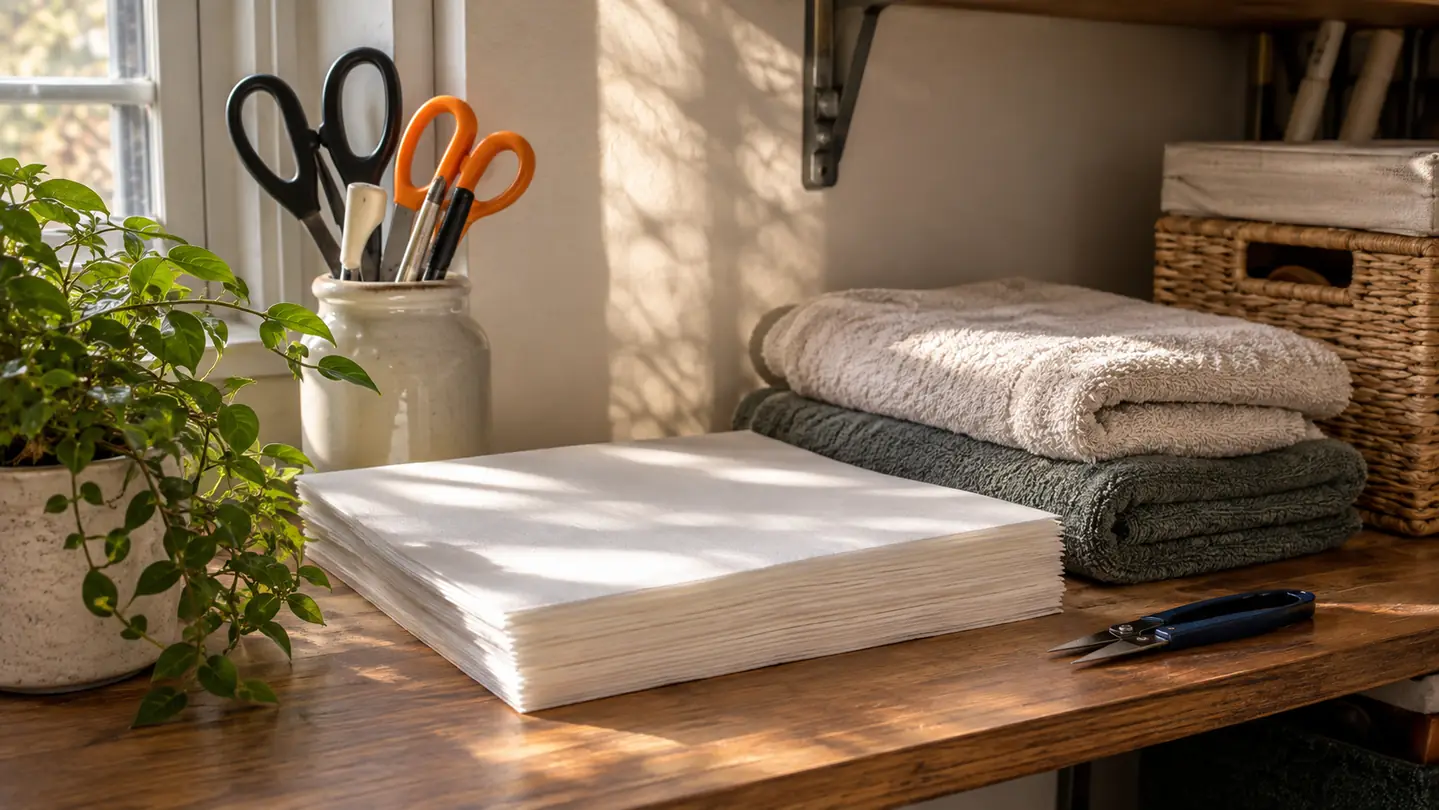
HBI H.B.I. PRODUCTS cuts these at 10 by 12 inches, 100 sheets to a pack, which covers the 5 by 7 embroidery field on my SE1900 with room to hoop the fabric. I ordered them with the machine in 2023 and I am on my third pack now.
Amazon Check Today's Price on Amazon →How I've Used It
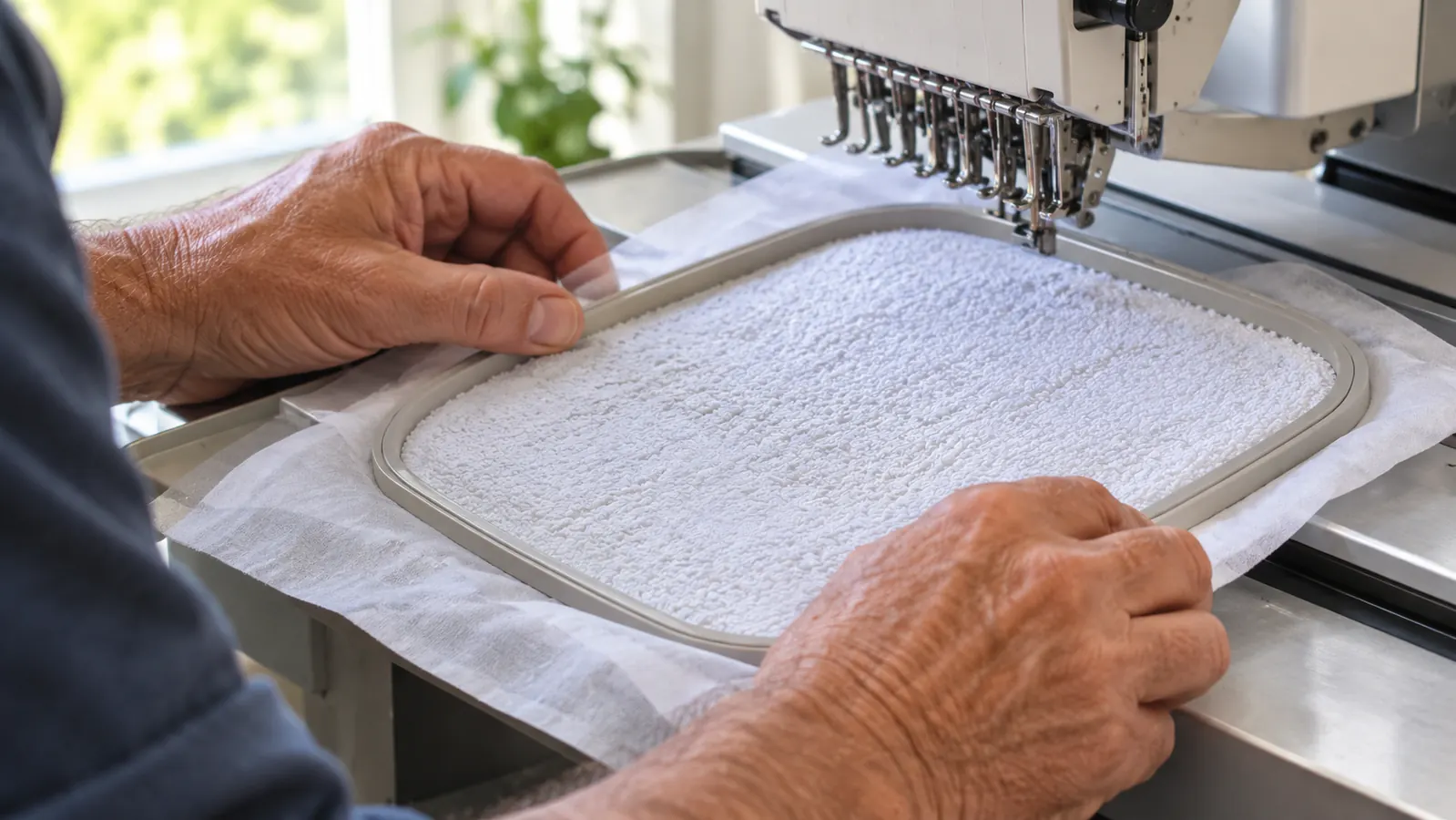
The SE1900 sits on the folding table by the window, and the stabilizer lives flat on the corner shelf within arm's reach. That sounds like nothing. It is not nothing. Sheets that stay flat go under the hoop without a corner fighting back, and I hoop a few pieces most days, so I notice. My routine has not changed since the second week I owned the machine. Cut the fabric with a seam allowance, lay one sheet of HBI under it, hoop both together with the Sew Tech 4 by 4 for hand towel monograms or the 5 by 7 for anything larger, then set the hoop on the embroidery arm and start.
On hand towels and bath towels I add a clear water-soluble topper on top, the generic roll from the craft store. The topper keeps terry loops from pushing up through the stitching, and the HBI underneath gives the needle something to hold. That combination, one sheet of tear away below and topper above, has done every towel monogram I have made since the fall of 2023. Fleece baby blankets get one sheet below and nothing on top. Canvas totes get one sheet. Cloth napkins get one sheet. The topper stays in the drawer unless the fabric has pile.
When the stitching is done I lift the hoop off, take the fabric out, and tear the stabilizer away. The tug is the part that makes new people nervous, and I understand why. On low and medium density designs it comes off in one pull without dragging the stitches or leaving a ring behind. My Singer snips handle the jump stitches at the machine, since the SE1900 does not trim them for me, and the small curved scissors in the table drawer trim anything close on the back of a blanket. Messy at first. Routine by the end of the first month.
What One Sheet Does Under the Hoop
The listing describes this as being for low to medium density designs on light and thick fabrics, and after all this time I would call that an honest description rather than a cautious one. A name in one of the built-in fonts, a small monogram in a circle, a short line of text across a napkin, all of that is low density and one sheet handles it. What matters is how much thread goes into a small area, not how large the design is on the fabric.
Light fabrics are easy. A cotton napkin or a canvas tote does not shift under the needle with one sheet of tear away below, and I have never had a design move on either. Heavier fabric is where the sheet has to work harder, because there is more weight hanging off the hoop and more pile for the stitches to sink into. That is not a knock on the stabilizer. It is how tear away behaves. The sheet is a backer, not a frame.
One thing I did not expect is that the sheet tears along the stitch line in a fairly straight direction once you get the motion of it, so what comes off is usually one piece and not a pile of shreds. I keep a small bin beside the table and it fills slowly. With a roll you would be cutting a length every single time and throwing away the tail of it.
The Thick Towel Problem
Here is the honest complaint. A thick bath towel with a dense monogram needs two sheets, and one is not enough. I found that out the way everyone finds it out, with a towel that puckered around the stitching after a wash, and I have doubled ever since. Two sheets of HBI, laid one on top of the other under the towel, plus the topper. The difference is plain. The towel lies flat, the stitches sit on the surface, and the hoop comes off clean.
I do not love that. Two sheets per thick towel means the pack empties faster, and it means an extra step at the table when I am trying to get through four towels before lunch. But I have stopped arguing with it. The sheets are precut at 10 by 12, so doubling them does not mean measuring twice. I lay one down, lay the second on top, square the edges with my hand, and hoop. That is maybe ten seconds.
Thin towels, hand towels and the fleece blankets do not need it. One sheet is right for those. The trick is knowing which item is in front of you before you start, and after a while you can feel it. If the fabric is heavy in your hands, double it. If it is not, do not.
What It Does Not Fix
Tear away will not hold a stretchy knit. I had one stretchy baby onesie for my granddaughter Lily, and a single sheet of HBI under it did nothing useful. That is the one job in the sewing room that gets the generic cut away mesh roll I bought in the spring of 2024, and the roll has been used for that and almost nothing else since. If you sew knits with any regularity, you need cut away in the drawer. This product is not that product.
It also will not replace a topper on terry cloth. The loops on a bath towel rise through the stitching unless something holds them down, and no amount of tear away underneath solves it, because the problem sits on top of the fabric. And it will not make a bad hooping good. If the fabric is loose in the hoop, the design will shift, and the stabilizer will be the thing you blame until you learn to hoop properly.
The last limit has nothing to do with the sheets. My machine has a 5 by 7 inch embroidery field, so a 10 by 12 sheet is generous for what I do. Someone with a bigger field would be trimming every sheet down, and a precut pack stops being convenient at that point. Worth knowing before you buy a hundred of them.
The Cut Away Roll in the Drawer
I keep one generic roll of cut away mesh for the rare knit item. Comparing the two is not quite fair, because they are for different jobs, but people ask me about it at the craft fair so I will say it plainly. Cut away stays in the garment. Tear away comes out. If the fabric needs to hold its shape after the stitching is finished, or the design is dense and the item will be washed hard, cut away is the safer choice, and it feels different in the hand, thicker and firmer.
For the towels, blankets, totes and napkins I actually make, tear away is the right choice. I do not want a stiff panel against someone's face on a bath towel, and I do not want to trim a mesh border on the inside of a tote. That is a preference about the finished item, not a claim that one is better than the other. Both belong in a sewing room. Mine just happens to be stocked with three tear away packs and one roll of mesh.
What the Months of Orders Have Taught Me
The thing I notice most is not the stabilizer doing something clever. It is that it never becomes the reason a project stops. When a neighbor texts about a towel for a baptism, I do not have to think about whether I have stabilizer, or whether it needs cutting, or whether the roll has enough left on it. There is a flat stack on the shelf, it fits the hoop, and I start. That sounds small until you have had a Saturday morning eaten by a missing supply.
The December booth at St. Peter's is where most of the towels go, and it is also where people pick things up and turn them over. Nobody has ever admired a stabilizer. But a monogram that sits flat on a towel after two washes, which is what people are really checking when they run a thumb across the stitching, comes down to this dull layer underneath. That is the whole case for keeping a stack on the shelf.
The doubling on thick towels is the only part of my routine that traces back to this product being thin. Everything else, the topper, the hooping, the jump stitches I trim by hand, comes from the machine or the fabric. So my summary is dull and accurate. It does its job, it does it without fuss, and the one adjustment it asks for is a second sheet on the heaviest items. That is a fair trade for something I can grab with one hand while the machine is still running.
What I Liked
- Precut at 10 by 12 inches, so the 5 by 7 field on my SE1900 is covered without measuring anything at the table.
- One sheet is enough for the fleece blankets, tote bags and napkins I make most weeks.
- Tears away in one pull on low and medium density designs, with no ring left around the stitching.
- Stays flat on the shelf between projects, so corners do not curl by the time I reach for one.
- 100 sheets to a pack, which is why I have only needed three of them.
- Made, converted and packaged in the USA, per the label on the bag.
Where It Falls Short
- Thin for dense designs on thick fabrics. Thick bath towels get two sheets doubled, every time.
- Nothing on the sheet tells you it needs doubling. You learn that from a puckered towel.
- It will not hold a stretchy knit on its own, and it is not meant to.
- Precut only pays off on a 5 by 7 field. A bigger hoop means trimming every sheet.
Two sheets under a thick bath towel is not a flaw in my technique. It is what this stabilizer asks for, and once I stopped arguing with it the puckering stopped.
Who This Is For
This is for someone with a 5 by 7 field machine who makes the everyday things I make: monograms on hand towels and bath towels, names on fleece blankets, a design on a canvas tote or a set of cloth napkins. It is for a person who wants to sit down and stitch without measuring and cutting first, and who would rather take a sheet off a stack than unroll something across the table. If you are new to machine embroidery, as I was in the fall of 2023, this is a forgiving first stabilizer, because there is no cutting step to get wrong and the tear is easy to read. It suits a small space too. A flat precut stack takes up a corner of a shelf and nothing else, which matters in a spare bedroom that still has to look like a bedroom.
Who Should Skip It
Skip it if you mostly sew knits, or if the designs you run are dense and heavy and go on garments that will be washed hard. That is a cut away job, and no amount of tear away underneath will do it. Skip it if your machine has a field larger than 5 by 7, because you will be trimming every sheet and getting none of the benefit of precut. Skip it if you want one product to cover everything, because this is not that. And skip it if you are the sort of person who will not double a sheet on a thick towel. The product will still work, but you will not like the towels, and you will blame the stabilizer when the answer was the second sheet.
One Flat Stack on the Shelf, and the Towel Gets Finished
HBI H.B.I. PRODUCTS precut 10 by 12 sheets, 100 to the pack, made and packaged in the USA, for low to medium density designs on light and thick fabrics. Third pack on my shelf, and doubling on the heaviest bath towels is the only adjustment I make.
Amazon Check Today's Price on Amazon →