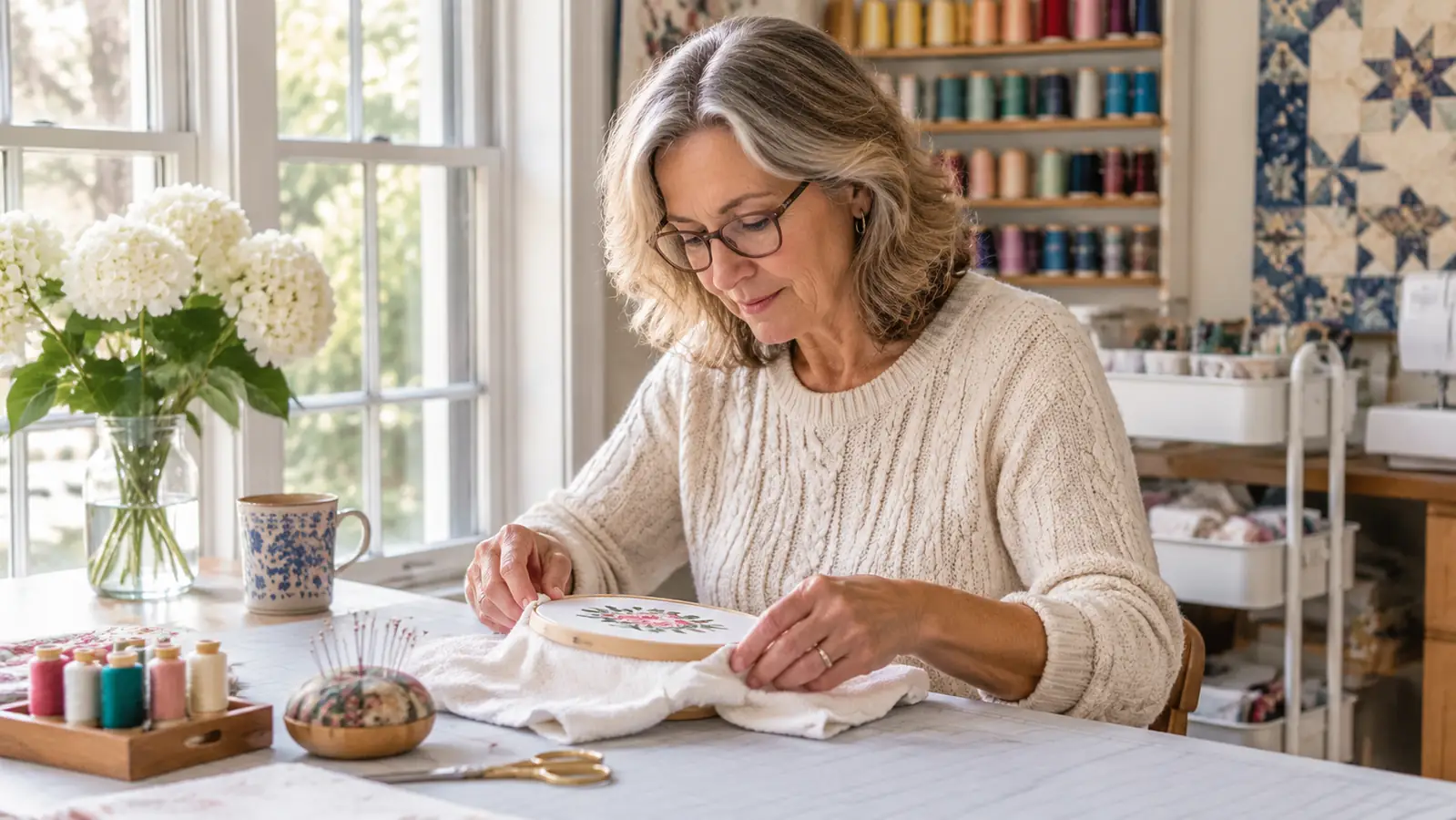
If you are only going to keep one backing on the shelf, keep the tear away. That is the short answer, and it is the one I give when someone corners me at the St. Peter's holiday craft fair with a hoop in one hand and a question in the other. Tear away handles the work I actually do: hand towels, bath towels, fleece baby blankets, canvas totes and cloth napkins. It goes under the fabric, it holds everything steady while the needle travels, and then it comes out with a pull of the fingers and nothing left inside the item.
Cut away is the other half of the answer, and it is less the loser in this comparison than the specialist. Cut away stays in the piece. That sounds like a drawback until you put a stretchy knit under the needle and watch the fabric shift while a tear away sheet politely lets it. I keep one generic roll of cut away mesh on the corner shelf for that job and nothing else. The precut pack from HBI H.B.I. PRODUCTS is what gets pulled out most weeks, and it is what I would hand a beginner before anything else.
Here is how the two stack up against each other in a spare bedroom with one folding table and good morning light. I am comparing the HBI precut tear away sheets against the plain cut away mesh roll I keep for knits, not against a particular cut away label, because I have never bought one worth naming.
| HBI Tear Away | Cut Away Mesh | |
|---|---|---|
| Format | Precut 10 x 12 inch sheets, 100 to a pack, nothing to cut | A roll you measure and cut at the table |
| Getting it out | Tears away by hand once the hoop comes off | Stays in the item and gets trimmed with curved scissors |
| Bulk in the finished piece | Nothing left behind in a towel or a napkin | A permanent border of mesh stays inside the item |
| Stretch knits | Fabric can still move under the stitches | Holds the knit steady during stitching and after |
| Dense designs | Listed for low to medium density, so I double up | Takes a heavy stitch count without pulling the fabric in |
| Thick bath towels | One sheet holds, two sheets for a dense monogram | Holds the stitching, but the edge cannot be torn out of terry |
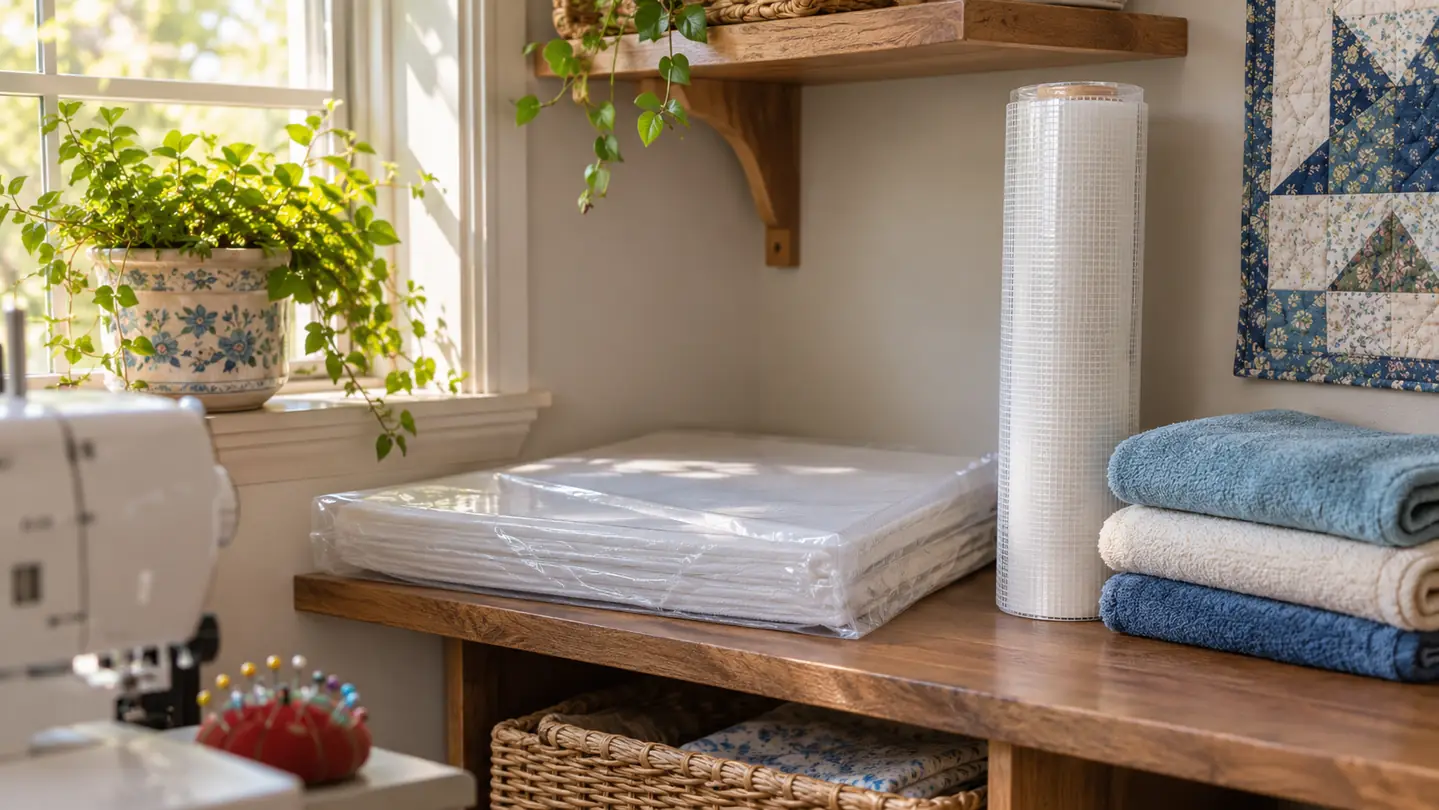
| Storage in a small room | Sheets stay flat on the corner shelf | The roll has to stand or lean somewhere |
| Best for | Towels, totes, napkins, fleece blankets | Onesies, leggings, dense work on unstable fabric |
Read the table twice, because the honest answer is that each one wins its share of rows and the rows that matter depend on what is in your hoop this week. If your list looks like mine, towels and blankets and totes, the left column takes most of them. If you are stitching on anything that stretches, the right column earns its place and you should not talk yourself out of it.
Where HBI Tear Away Wins
The first win is the shape of the thing. The sheets come precut at 10 by 12 inches, 100 to a pack, and that size sits over my 5 by 7 inch field with room to spare on every side. I hoop the towel, I lay a sheet underneath, I check that the edges clear the frame, and I am stitching inside a minute. No measuring, no rotary cutter, no mat, no wasting the first inches of a roll because I misjudged the angle. When you stitch four monogrammed hand towels in an afternoon, that saved minute four times over is the difference between finishing before supper and finishing after it.
Second, it leaves nothing behind. Once the hoop comes off, I tear the HBI H.B.I. PRODUCTS sheet away in one slow pull and the back of the towel is just the back of the towel. That matters most on the fleece baby blankets. A blanket with a stiff mesh border inside it does not drape the way a blanket should, and I have felt the difference on a gift I made for my granddaughter Lily. Tear away lets a blanket stay a blanket. It is also why I trust it on napkins and on the hand towels that get washed hot, folded and stacked.
The pack is made, converted and packaged in the USA, which is a small thing I happen to like. The listing describes it as being for low to medium density designs on both light and thick fabrics, and that matches what I have found at the machine. A three letter monogram on a bath towel sits well inside that range. A dense filled design with a lot of coverage does not, and no amount of good intentions will change that.
Storage is the unglamorous win. The sheets live flat on the corner shelf, still in the pack, and they stay flat. A roll wants to stand up or unroll itself or lean against something, and in a room with one folding table and a rolling cart, floor space is already spoken for. Three packs in, I have never once had to hunt for a sheet.
Where Cut Away Wins
Cut away wins on anything that moves. The mesh stays in the fabric, keeps it from stretching while the needle works, and then keeps it from stretching afterwards, which is the part people forget. A stretchy baby onesie for Lily was the item that taught me this. A tear away sheet under that fabric let it shift and the stitches came out uneven at the edges. Cut away held it and the design sat where it was supposed to sit. If you stitch knits, ribbing or anything with a bit of give, this is not a close call.
It also wins on density. The HBI sheets are honest about their range and I appreciate that, but a design with heavy coverage on a thick towel needs two sheets doubled, and even then I find myself watching the hoop more closely than I would like. Cut away takes a heavy stitch count without complaint. There is a moment when you tear away a dense design where the fabric wants to follow the paper, and you have to hold the towel flat and pull slowly. Cut away skips that moment entirely, because you never tear it at all.
Nine items out of ten in my sewing room are towels, totes or blankets, and every one of them gets a tear away sheet. The tenth is a knit, and that one gets the mesh.
The 100 sheet pack that covers nine jobs out of ten
Precut 10 by 12 inch tear away sheets for low to medium density designs on light and thick fabric. It is the backing I have bought three times since October 2023, and the one I reach for first.
Amazon Check Today's Price on Amazon →How I Decide, Item by Item
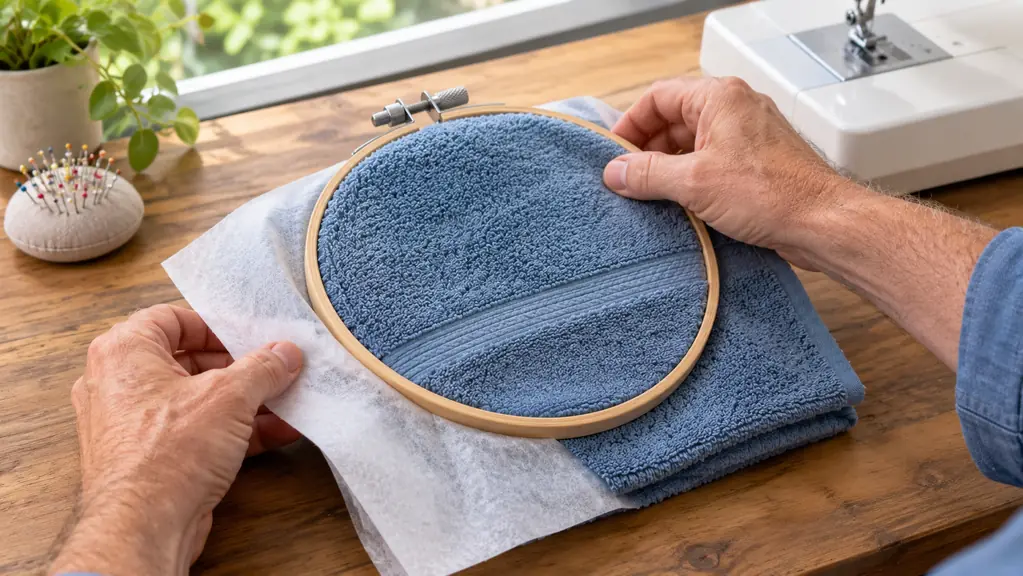
Hand towels get one sheet, a 4 by 4 hoop and a name in the built in font. Bath towels get two sheets doubled, because the terry is thick and a single sheet feels thin under a dense monogram. Fleece baby blankets get one sheet and a water soluble topper on top so the stitches do not sink into the pile. Canvas totes get one sheet and a slightly slower speed. Cloth napkins get one sheet and a smaller design, because a napkin does not want heavy backing behind it.
One thing worth saying plainly is that the sheet underneath is not the whole sandwich. On towels with any pile I use a clear water soluble topper on top so the stitches sit on the surface instead of disappearing into it. That topper is a separate purchase and a separate habit, and no stabilizer underneath will do that job for you, no matter how many sheets you double.
There is a practical point about the hoops too. My 4 by 4 gets most of the monogram work and a 10 by 12 sheet covers it several times over. I fold the excess under rather than trimming it off, which keeps the rest of the sheet usable for a second small item if the first one only used the middle. That is the sort of small economy that never shows up in a stitch count, and it is part of why a 100 sheet pack has lasted me as long as it has.
Does Tearing It Out Pull the Stitches Loose?
This is the question I get most, usually from someone holding a towel they have already stitched once and are nervous about ruining. It can pull stitches, if you pull across the design instead of away from it. I hold the towel flat with one hand, pinch the sheet close to the stitching with the other, and pull outward and down, away from the design rather than sideways under it. On a dense design I go slowly, in two or three pulls instead of one. It takes about ten seconds and I have not lost a stitch to it since my first month at the machine.
What does happen, on a thick towel with only one sheet, is that the paper comes away in ragged pieces and leaves crumbs in the terry. That is the doubling problem again, not a tearing problem. Two sheets come away in a cleaner piece. If you are picking bits of backing out of a towel with the snips, you were under backed rather than too rough with your hands.
The other half of the question is whether the item feels different afterwards. On a towel or a napkin, no. The fabric goes back to being fabric. On a fleece blanket there is a slight change in the middle of the blanket until the first wash, and then it is gone. These have gone through a hot wash and a dryer in my house and the stitching has held.
Two Things I Got Wrong
The first was doubling too late. For a couple of months I put a single sheet under thick bath towels and wondered why the edges of a monogram looked crowded and slightly raised. Two sheets solved it, and the fix cost me nothing except the willingness to use more paper. If a design looks like it is sitting on top of the towel rather than in it, add a sheet before you blame the machine or the thread.
The second was assuming cut away was the advanced choice and tear away was the beginner's crutch. That is backwards in one specific case. On a knit, tear away is the riskier pick, and someone who does not yet know how a properly hooped piece should feel will not notice the fabric moving until the design is already off. Learn on towels and totes. Move to knits when your hands can feel the difference.
Who Should Buy Which
Buy the HBI H.B.I. PRODUCTS tear away sheets if your work looks like mine: towels, blankets, totes, napkins, gifts and small orders that arrive by text from friends and church people. Buy it if you want to hoop an item and start stitching without cutting anything first. Buy it if you are new and want to learn what a properly hooped piece of fabric feels like, because it is forgiving and it is easy to practice with. Keep the cut away roll for the knits, and do not feel you have to pick one philosophy and defend it for the rest of your life.
Buy the cut away if you stitch stretchy fabric more than once a month, or if your designs are dense enough that the precut sheets need doubling every single time. Buy both if you are where I am, which is mostly towels with the occasional onesie on the table. Two backings on a corner shelf is not clutter. It is a decision you make once per project instead of once per panic.
Start with the pack I have bought three times
Precut 10 by 12 inch tear away sheets, 100 to a pack, made for low to medium density designs on light and thick fabric. Third pack since October 2023, and still the first thing I reach for.
Amazon Check Today's Price on Amazon →