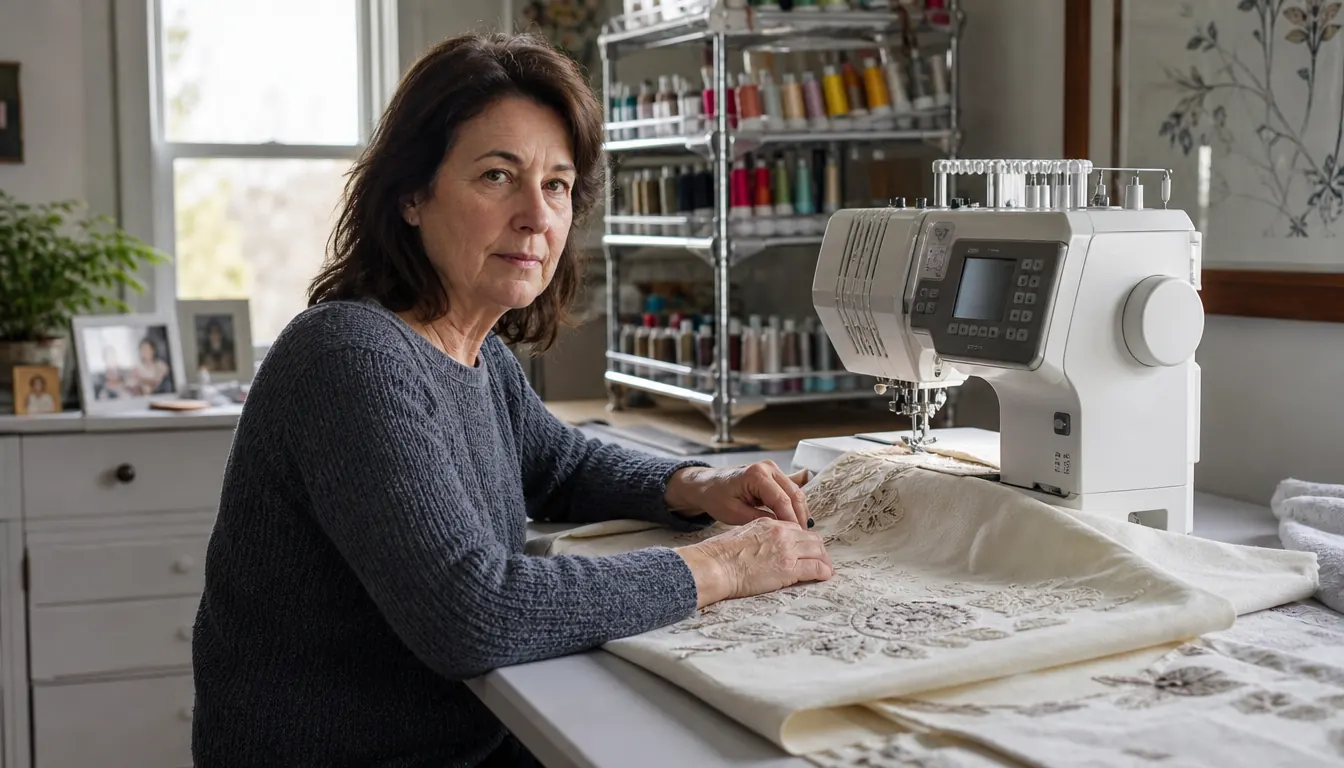
The hoop that came with my Brother SE1900 was fine. That was the problem. One hoop means you stitch a towel, take it off, re-hoop the next towel, and stand there while the machine runs. I bought the Sew Tech hoop set in March 2024, five months into machine embroidery, because I wanted a 4 by 4 for hand towel monograms and a second 5 by 7 so I could keep hooping while the first item stitched. That is exactly what the set gave me, along with two sizes I did not need and one screw that has become the small daily annoyance in my sewing room.
I am not going to tell you this set is wonderful. It is useful. The plastic is light but sturdy, the grids are clear, and the hanging buckle keeps four hoops off my cutting mat. But the 5 by 12 hoop has never held a stitch in my house. The SE1900 has a 5 by 7 field, so the largest hoop in the set cannot run. I knew that when I ordered. I bought the set because the 4 by 4 and the second 5 by 7 were worth the clutter, and that is still true. If you are shopping a full set for a 5 by 7 Brother, that is the first thing nobody tells you.
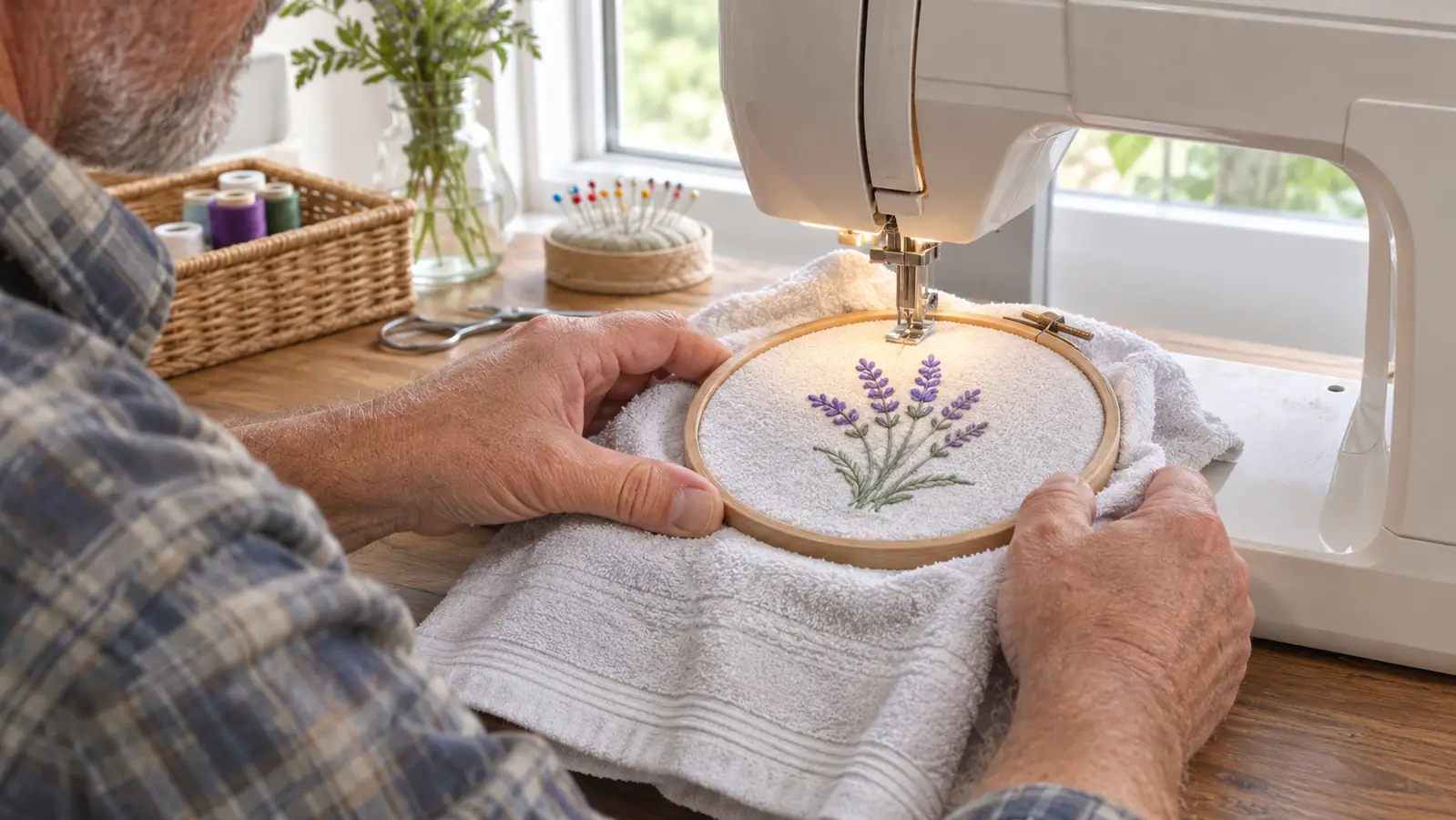
The second thing nobody tells you is that the screw is the real daily friction. The adjustable metal screw holds fabric firmly. On cotton napkins and canvas totes, I tighten it by hand and move on. On a thick bath towel, hand tightening is not enough. I keep a small screwdriver in the table drawer and use it to get the screw firm. That is not a defect in the Sew Tech set. It is the tradeoff of a metal screw on a plastic hoop. If you have hand strength and no patience for tools, you will notice it every time you hoop a heavy towel.
The Quick Verdict
Four hoops, two workhorses, one size that cannot run on a 5 by 7 field, and a screw that wants a screwdriver on thick towels. Useful for the sizes I actually use, not a complete answer for everyone.
Amazon Check Today's Price →The second 5 by 7 is the quiet reason to buy this set
The 4 by 4 and the second 5 by 7 are the two hoops I reach for on almost every order. If you run a Brother SE1900 or another 5 by 7 machine, this is the set that ends the one hoop wait.
Amazon See the Sew Tech Hoop Set on Amazon →How I've Used These Hoops Since March 2024
I bought the set with my own money in March 2024. By then I had been stitching for five months, long enough to know that one hoop was slowing me down. My routine is simple. I hoop a hand towel, stitch the monogram, take it off, and while the machine is running I hoop the next one. The second 5 by 7 makes that possible. Without it, I stand there waiting for the machine to finish, and the whole afternoon feels twice as long.
The 4 by 4 does most of the small work. Hand towel corners, cloth napkins, the front of a canvas tote, a name on a baby bib. The 5 by 7 handles bath towels and fleece baby blankets. The 1 by 2.5 has been used a handful of times for small names on baby bibs. The 5 by 12 has never been used because the SE1900 field is 5 by 7. It stays on the hanging buckle beside the table, which is a polite way of saying it is decoration.
I hang the set on the buckle on a hook beside the table. That sounds like a small thing, and it is, but it keeps the hoops off the cutting mat and out of the way when I am laying out fabric. The clear markings on the hoops are the other quiet feature. I can line up a towel corner without measuring twice. The grids do not make me a better embroiderer, but they make me a faster one, and faster matters when I have four towels to finish before church on Sunday.
The Sizes, and the One That Just Hangs There
The 4 by 4 is the hoop I would buy on its own if I could. It is the right size for a monogram on a hand towel, and it is small enough to move around the corner of a napkin without fighting the fabric. The 5 by 7 is the standard field on my machine, so it handles the bigger designs and the thick bath towels. The second 5 by 7 is the one that keeps me stitching instead of waiting. The 1 by 2.5 is small, almost too small for anything but a name on a bib, and I use it less than I expected.
The 5 by 12 is the odd one out. It is a real hoop, and it is well made, but it cannot run on a 5 by 7 machine. If you have a larger Brother with a bigger field, it may be useful. On my SE1900, it is a size that exists in the set and nowhere in my work. I am not sorry I bought the set, because the two hoops I use every week are worth it. But I would not buy the set again just to get the 5 by 12. Nobody needs a hoop that cannot hold fabric under the needle.
The Screw Is the Whole Story
Every hoop in the set has an adjustable metal screw. The screw is what clamps the fabric, and it is also the part that decides whether hooping is pleasant or annoying. On a cotton napkin, I can tighten it by hand and the fabric stays drum tight. On a thick bath towel, hand tightening is not enough. I keep a small screwdriver in the table drawer, and I use it to get the screw firm. That is the one annoyance I have with the Sew Tech set, and it is not a small one when I am hooping six towels in a row.
I have tried to be careful not to over tighten. Plastic hoops can leave marks if you clamp too hard, and thick towels will show hoop burn if you leave them in the hoop after stitching. I take the towel out right after the machine stops. On fleece baby blankets, I use a lighter touch and remove the blanket immediately. That is not a flaw in the set. It is how hooping works. The hoop holds the fabric, but you still have to use your judgment.
The screw has not stripped, and the hoops have not cracked. I have used them since March 2024, and they still hold fabric as well as they did on the first day. The plastic is light, the metal screw is the only hardware, and the set has survived being hung on a hook and pulled down every week. I cannot tell you how many years it will last. I can tell you that after months of steady use, nothing has loosened or failed.
The Grids and the Hanging Buckle
The clear markings on the hoops are more useful than I expected. I line up the corner of a towel with the grid, and I know where the center is before I tighten the screw. That saves me from re-hooping a monogram that came out crooked. The hanging buckle is the other feature I use every day. The whole set hangs on one hook beside the table, and I can grab the size I need without digging through a box. If you have a small sewing room, that matters. My room is the spare bedroom upstairs, with one six foot folding table against the window, and I do not have space for a pile of hoops.
I do not use the grids for every project. On a fleece blanket, I care more about the nap of the fabric than the marking. On a canvas tote, I use the grid to keep the design straight. The markings are a reference, not a rule. That is how I treat them. They help, and then I make the final call with my hands.
Hoop Burn, Fleece, and What I Do Instead
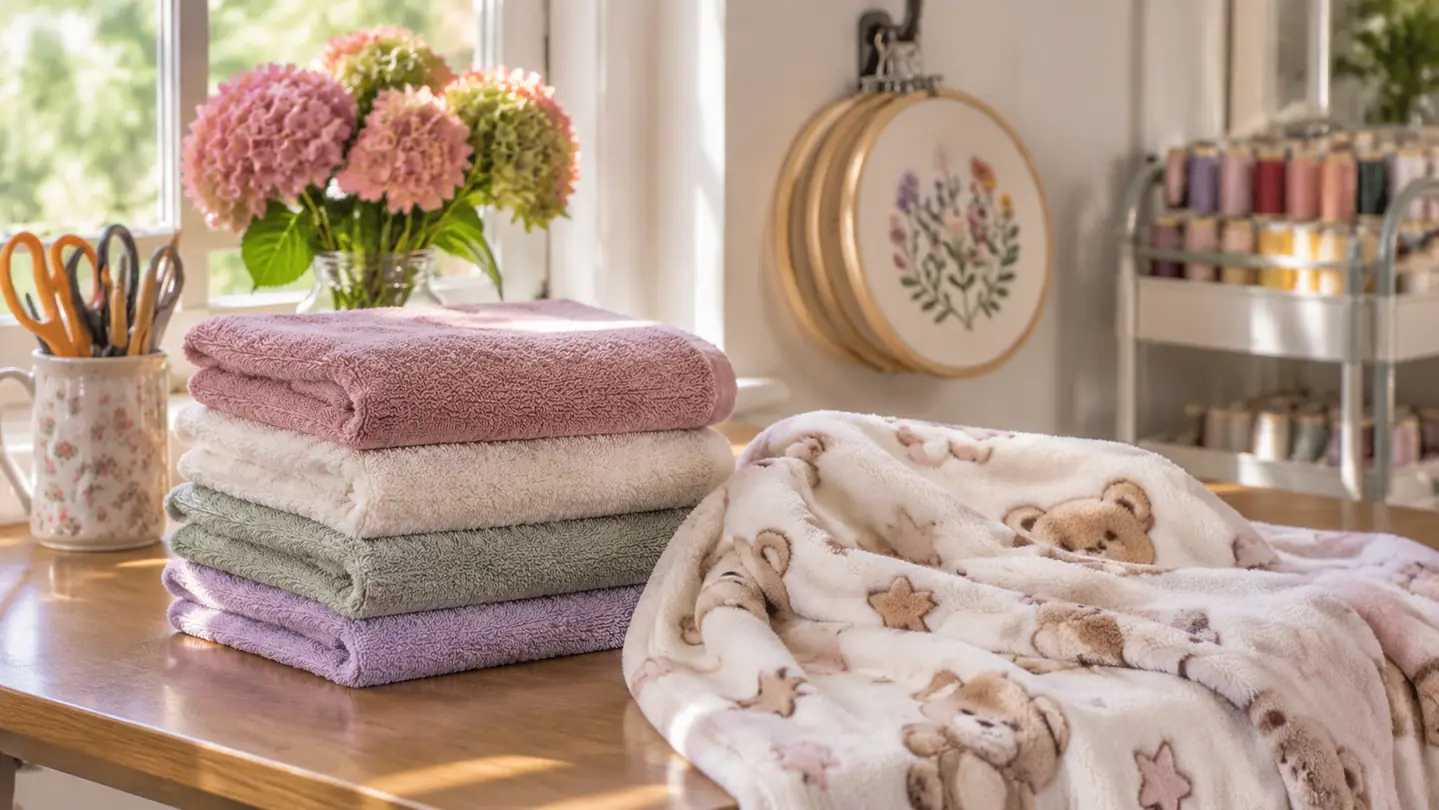
Hoop burn is the mark left on fabric when the hoop presses too hard or stays on too long. I had it happen once on a fleece baby blanket early on, and I learned to avoid it. I do not over tighten the screw on fleece. I take the blanket out of the hoop as soon as the machine stops. I also use a piece of tear away stabilizer under the fleece, which is my normal practice. The hoop is not the villain. The villain is leaving the fabric clamped while I answer a text.
On thick bath towels, I use two sheets of tear away stabilizer and a water soluble topper. The hoop has to hold all of that, which is why the screw needs a screwdriver. On hand towels, one sheet of tear away is enough. The set does not change my stabilizer routine. It just gives me the right size hoop for the job, which is the whole point. If you are new to embroidery and you think a hoop set will solve your hooping problems, it will not. It gives you options. You still have to learn how fabric behaves.
What I'd Tell a Friend Before She Buys
I would tell her to check her machine field before she orders. If she has a 5 by 7 Brother, the 5 by 12 in this set will not run. That is not a reason to skip the set if she wants the 4 by 4 and a second 5 by 7, but she should know it going in. I would also tell her to keep a small screwdriver in the drawer. The screw is not hard to use, but it is not tool free on thick towels. And I would tell her that the 1 by 2.5 is small. It is useful for names on bibs, and not much else.
I would not tell her that this set made me a better embroiderer. It did not. It made me faster because I can hoop the next item while the machine is running. That is the honest benefit. The stitches come from the machine, the design comes from the computer, and the hooping comes from me. The set is a tool that removes a bottleneck. It is not a shortcut around learning.
I also would not tell her to buy the biggest set she can find. Four hoops is more than I need. Two would do most of my work. But the set is sold as a set, and the two hoops I use are worth having. That is the tradeoff. If you want every size, this set gives you every size. If you want only the sizes you will use, you may end up with one hoop that hangs on the hook.
What I Liked
- The second 5 by 7 lets me hoop the next item while the machine stitches.
- The 4 by 4 is the right size for hand towel monograms and napkin corners.
- Clear markings and grids help me center a design without measuring twice.
- The hanging buckle keeps the set together on one hook in a small sewing room.
- The adjustable metal screws hold thin and medium fabrics firmly.
Where It Falls Short
- The 5 by 12 cannot run on a 5 by 7 machine and has never been used in my sewing room.
- The screw needs a small screwdriver to get tight on thick bath towels.
- The 1 by 2.5 is too small for most towel work and gets little use.
The 5 by 12 has never held a stitch in my house. My machine tops out at 5 by 7, so that hoop stays on the hanging buckle and reminds me to check the field size before I buy anything else.
Who This Is For
This set is for the home embroiderer with a 5 by 7 Brother machine who is tired of stopping after every item. If you stitch monograms on hand towels, napkins, totes, or baby blankets, the 4 by 4 and the second 5 by 7 will earn their place. It is also for someone who likes a hanging buckle and clear grids, and who does not mind a small screwdriver on thick towels. It is a practical set for a small sewing room, not a showpiece.
It is also for the person who has one hoop and keeps wishing she had another. That was me. The second 5 by 7 changed my afternoons more than any other part of the set. If you are in that spot, the set makes sense. You will use the 4 by 4 for small work and the second 5 by 7 for everything else.
Who Should Skip It
Skip it if you have a machine with a larger field and you already own the hoops you need. Skip it if you want magnetic hoops and tool free tightening. Skip it if you only stitch 5 by 7 designs and you already have two 5 by 7 hoops. The 5 by 12 will not help you on a 5 by 7 machine, and the 1 by 2.5 is too small for most towel work. If you are looking for a set that solves every hooping problem, this is not that set.
Skip it also if you hate keeping track of tools. The screw is adjustable, but it is still a screw. You will want a small screwdriver within reach. If that sounds like a nuisance, a different style of hoop may suit you better. I have not owned magnetic hoops, so I cannot tell you they are better. I can tell you that this set requires a screwdriver on thick towels, and you should know that before you buy.
The 4 by 4 and the second 5 by 7 are the ones that earn their keep
If you run a 5 by 7 Brother and you are still working with one hoop, this set removes the wait between items. The 5 by 12 will hang on the buckle, and the screw will ask for a small screwdriver on thick towels. The two hoops you use every week make up for both.
Amazon See the Sew Tech Hoop Set on Amazon →