
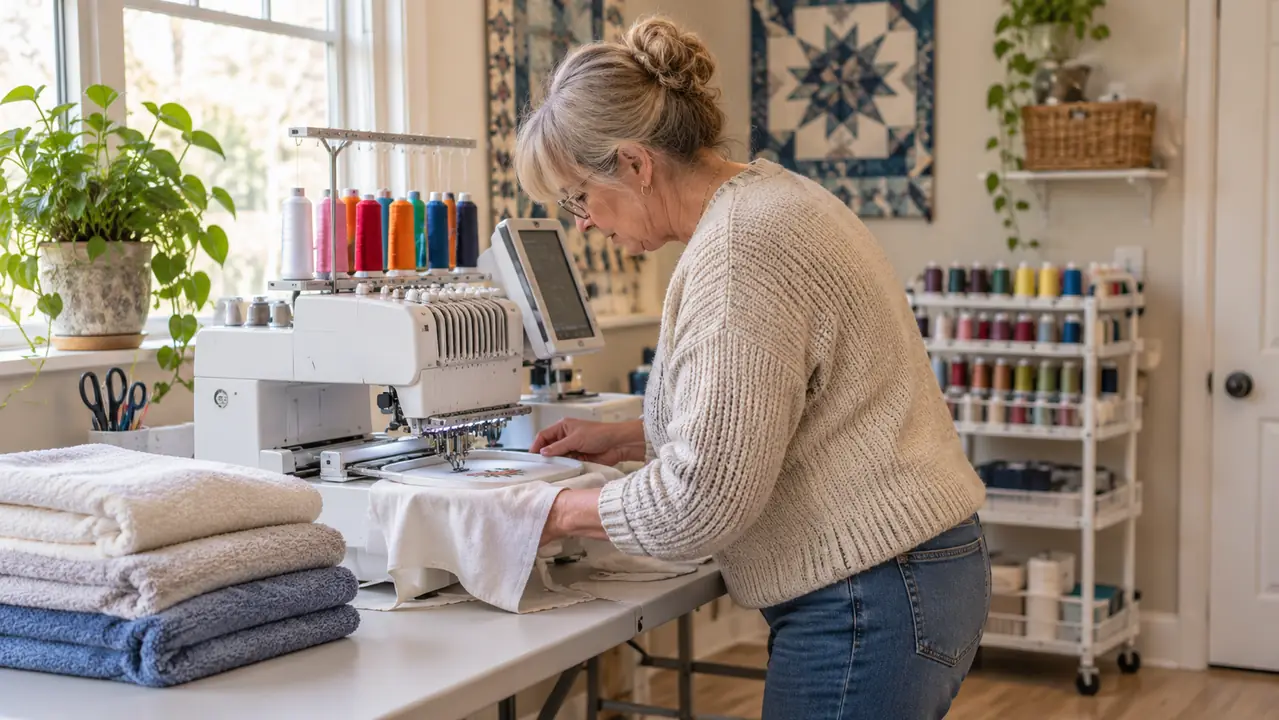
Terry cloth is where I learned that my machine was never the problem. A hand towel looks flat and forgiving until you hoop it, and then the nap and the give in the weave start arguing with the needle. My first batch of monogrammed towels came out with a pale halo around every letter, a soft ring where the fabric had moved and the stitches had not. I blamed the tension, then the thread, then my own hands. It was none of those. The towel was shifting under the needle by a hair, all the way around, and a hair is enough to make a monogram look homemade in the wrong way.
What fixed it was stabilizer, used properly and used generously. I run HBI tear away sheets under the towel, precut 10 by 12 inch, and I stopped pretending that one thin layer was enough for thick fabric. The box on my corner shelf is the 100 count from HBI H.B.I. PRODUCTS, made in the USA, and it is one of the few things I bought in my first month that I am still buying now. The order of operations below is what I do start to finish, every towel, and it has not changed since about three months in. Five steps, and the first one carries most of the weight.
The precut sheets that ended my towel halos
Ten by twelve inches, 100 to the pack, made for low and medium density work on light and thick fabric. This is the box that sits flat on my corner shelf.
Amazon Check Today's Price on Amazon →Step 1: Double the Stabilizer Under a Thick Towel
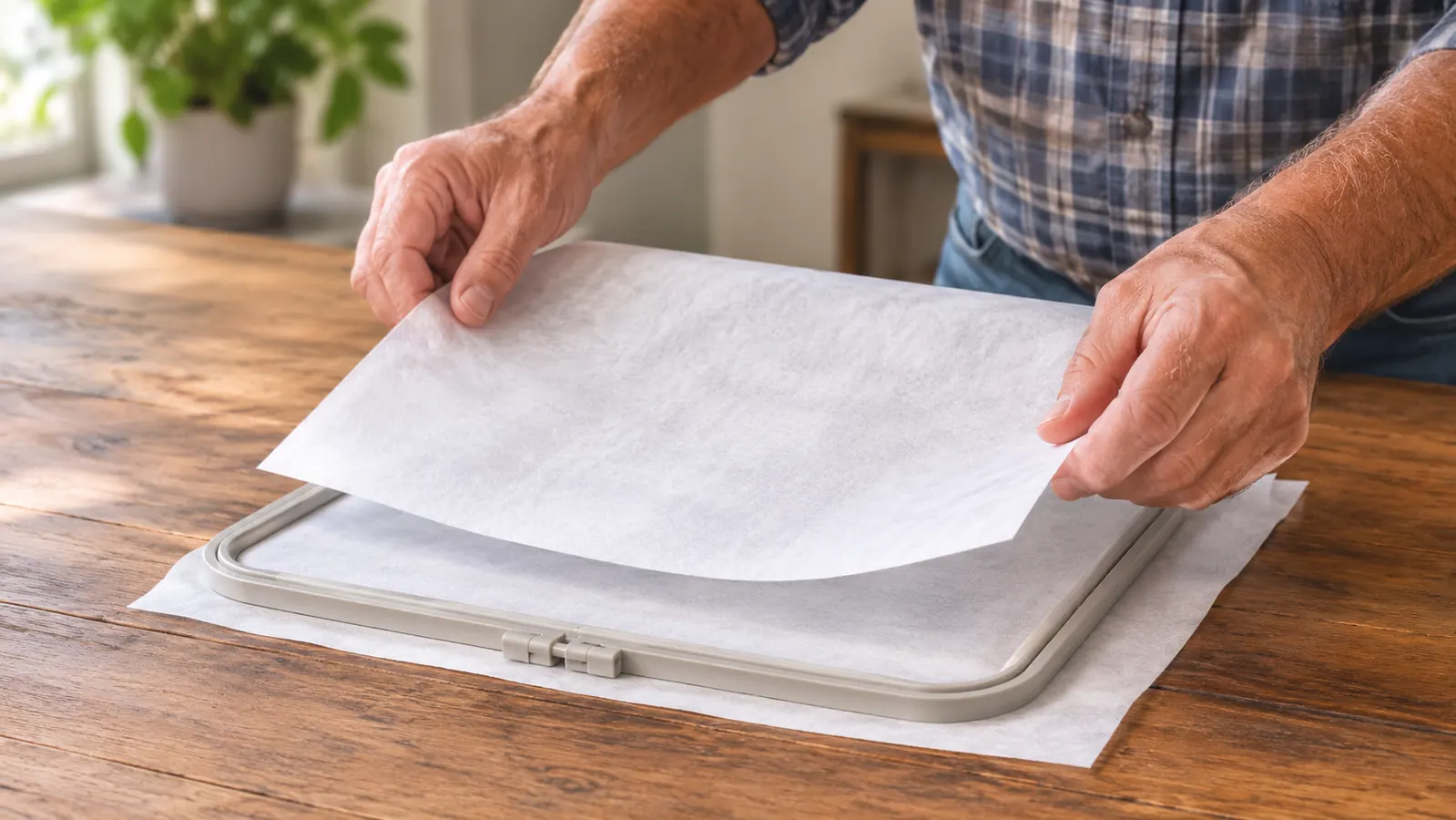
A single sheet of HBI tear away is thin, and thin is on purpose. It is what lets the sheet pull away cleanly when the design is finished. But thin also means that one layer under a thick bath towel has very little to give, and a filled monogram on terry asks for more than it has. I use two sheets now, laid one over the other and offset by an inch or so in each direction, with the towel on top of both.
The rule I follow is not clever. If the towel is a bath towel, it gets two sheets. If the design is wider than my palm, it gets two sheets, hand towel or not. The HBI H.B.I. PRODUCTS listing describes these sheets as suited to low and medium density designs on both light and thick fabrics, and a heavy monogram on terry is not low density no matter how small it looks on the laptop screen. Density is about stitches in a space, not about inches.
Two sheets cost a few seconds and one extra piece out of the pack. A redo costs an evening. I have unpicked a monogram from a bath towel exactly once, with the small curved scissors and a good deal of muttering, and I have no plans to repeat the experience. If you take one thing from this whole page, take this: the layer underneath is not where you economize.
Step 2: Hoop It Snug, Not Drum Tight
Puckering gets blamed on loose hooping, so people hoop tighter, and then the towel comes out of the hoop with a hard ring pressed into the terry that will not relax. What I want is taut enough that the fabric does not sag when I lift the hoop by one edge, and no tighter than that. Terry stretches. Pull it hard into the hoop and it springs back the moment it is released, and the stitches that sat flat inside the ring are suddenly crowded together outside it.
For towels I hoop the stabilizer and the towel together rather than floating the towel over a hooped sheet. Terry is thick, and I want the hoop holding all of it. The 5 by 7 hoop that came with the SE1900 does most of my hand towels. For bath towels I reach for the 5 by 7 from the Sew Tech set, mostly because that screw will hold firm on thick fabric, and yes, it wants a small screwdriver to get there.
The 4 by 4 from the same set is what I use for a hand towel monogram that sits alone in the middle, since it is lighter to hold and easier to center by eye. Whatever hoop you use, take the towel out as soon as the machine stops. Leaving it in while you answer the door and then forgetting it for an hour is how you get hoop burn along the edge of a design, and that mark does not wash out.
Step 3: Float a Water-Soluble Topper Over the Nap
The underside is only half of the problem. Terry has loops standing up on the surface, and a satin stitch laid across those loops will sink into them and come out furred at the edges. A clear water-soluble topper holds the loops down flat while the needle works. I buy a plain roll at the craft store, nothing special about it, and cut a piece a couple of inches bigger than the design in every direction so the hoop has something to grip at the edges.
The sandwich is simple: two sheets of HBI tear away underneath, the towel, the topper on top, all hooped together. The topper does not need to be tight, it only needs to be present and flat. When the design is finished I tear the large pieces of stabilizer away from the back, then hold the towel under a running tap or dab at the front with a wet cloth until the topper is gone. It dissolves quickly and it does not leave the stiff patch that people complain about when they use too much of it.
A note on how much topper to cut: more than you think. If the topper edge falls inside the hoop ring, the hoop grips the towel alone at that spot and the fabric creeps. I cut a rectangle that runs past the design by two inches on all four sides and let the hoop take the excess.
Some embroiderers skip the topper and slow the machine down instead. That works better on flat cotton than it does on terry. On a bath towel I would not run a monogram without a topper, and on a hand towel I use one whenever the design has any satin stitch at all.
Step 4: Pick a Design Terry Cloth Can Hold
Some designs ask more of a towel than a towel can give. Dense fills, tiny detail, a solid block of stitching half an inch wide: all of that lays stitch on top of stitch into fabric with a pile, and the result is stiff, cupped and puckered no matter how carefully you hooped it. Simple satin stitch letters and open outlines behave. Most of what I stitch is monograms and names on hand towels, so this is not a limitation I mind much.
The other thing I do is keep the design off the hem. A towel hem is a doubled band of fabric, thicker than the field around it, and it hoops unevenly no matter how careful you are. Stitch across it and you get a line where one side of the letter sinks and the other floats, and no amount of stabilizer will fix that. An inch of clearance is enough, and a monogram looks better sitting a little high on the towel anyway.
On the SE1900 I am working inside a 5 by 7 inch field, so a name with a small border about fills it. If I want something larger I split the design across two hoopings, which is a different afternoon entirely. For towels, small and clean beats large and crowded every time.
Step 5: Tear Away Slowly and Finish the Back
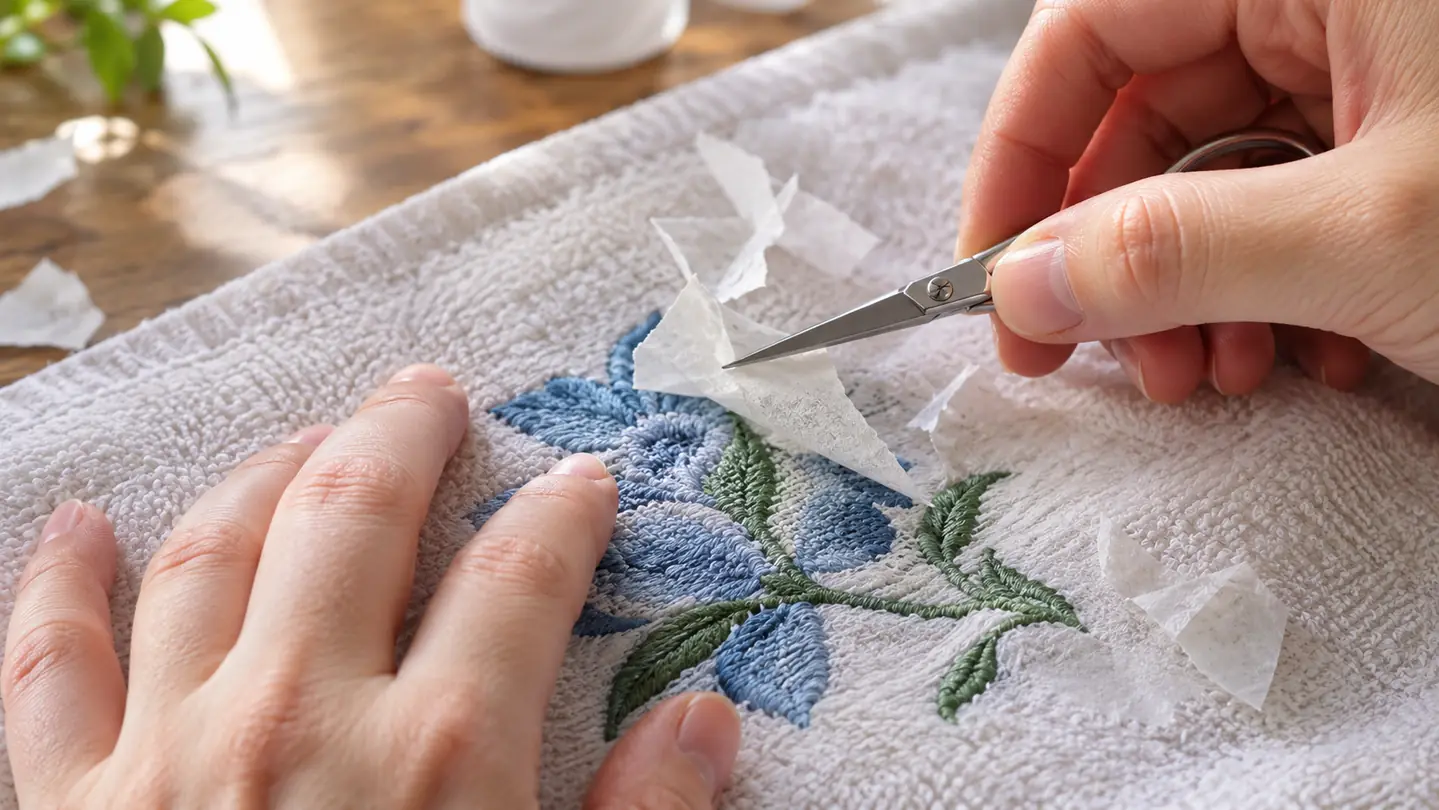
Tearing the stabilizer off is where people rip first and regret it. Pull the sheet away from the stitches rather than across them, and hold the design flat with your other thumb while you do it. The point is to support the stitching so the tear does not tug on the letters. If a corner fights you, tear it in the other direction instead of pulling harder.
Small islands left between letters come out with the snips, tips flat against the fabric so you are cutting the stabilizer and not the stitch. The Singer snips hang on a ribbon by the machine and that is exactly what they are for. On a hand towel the back shows every time it hangs on a hook, so the back of the work gets the same attention as the front.
Last, press it. A press cloth over the towel, a warm iron, no steam, and let it lie flat until it is cool before you fold it. Direct heat flattens the loops and an iron straight on a polyester monogram will leave a shine that never comes out. The finished towel should look like the name was always meant to be there, which is the whole point of the exercise.
If a letter still looks slightly sunken at one end, do not reach for the iron and press harder. Nine times out of ten that letter was stitched with too little underneath it, and the fix is on the next towel, not this one. Chalk it up and double the sheet next time.
Two sheets of HBI underneath, one strip of topper on top, and the halos stopped. Same machine. Same thread. Same towel.
What Else Helps
Thread matters here whether it feels related or not. A thread that breaks mid letter forces a stop, a stop means the hoop gets bumped or the fabric eases, and a small shift is a pucker. I use the Brothread 40 weight polyester kit. The colors are colorfast through hot washes, and I have not had a break in the middle of a monogram in a long while. The few spools that like to unwind themselves get a thread net over the top, which is a two second fix.
A fresh needle helps more than people expect. Terry is abrasive on a needle point, and a needle that has done a few thousand stitches will push the fabric aside instead of parting it cleanly. I change mine more often than the manual suggests and I do not feel bad about it, since a needle costs less than a redo.
The least popular habit is the one that saves the most towels: stitch a scrap first. Not a scrap of cotton, a scrap of the same terry you are about to use, hooped the same way, with the same number of stabilizer sheets and the same topper. Two minutes and one throwaway monogram tell you whether the sandwich is right before you touch the good towel. I still do it whenever the next towel is heavier than the last one I ran.
And keep the sheets flat and dry on the shelf. A precut sheet that has been folded over on itself in a basket will leave a crease line that shows through a thin towel, and a sheet stored somewhere damp will not tear cleanly. Mine live flat on the corner shelf, still in the box, which is also why I always know how many are left.
None of this is complicated. Stabilizer, hoop tension, topper, design choice and a patient tear, in that order, every single towel. Two sheets instead of one, an inch of clearance from the hem, and a slower hand on the tear. The towels that leave my table now go out with the letters sitting flat in the terry, and the only thing that changed was the layer underneath them.
100 precut sheets, flat on the shelf, ready for the next towel
The HBI H.B.I. PRODUCTS pack is ten by twelve inch tear away, made in the USA and sold in a 100 count. The sheet count matters less than the habit of using two when the towel is heavy.
Amazon Check Today's Price on Amazon →