
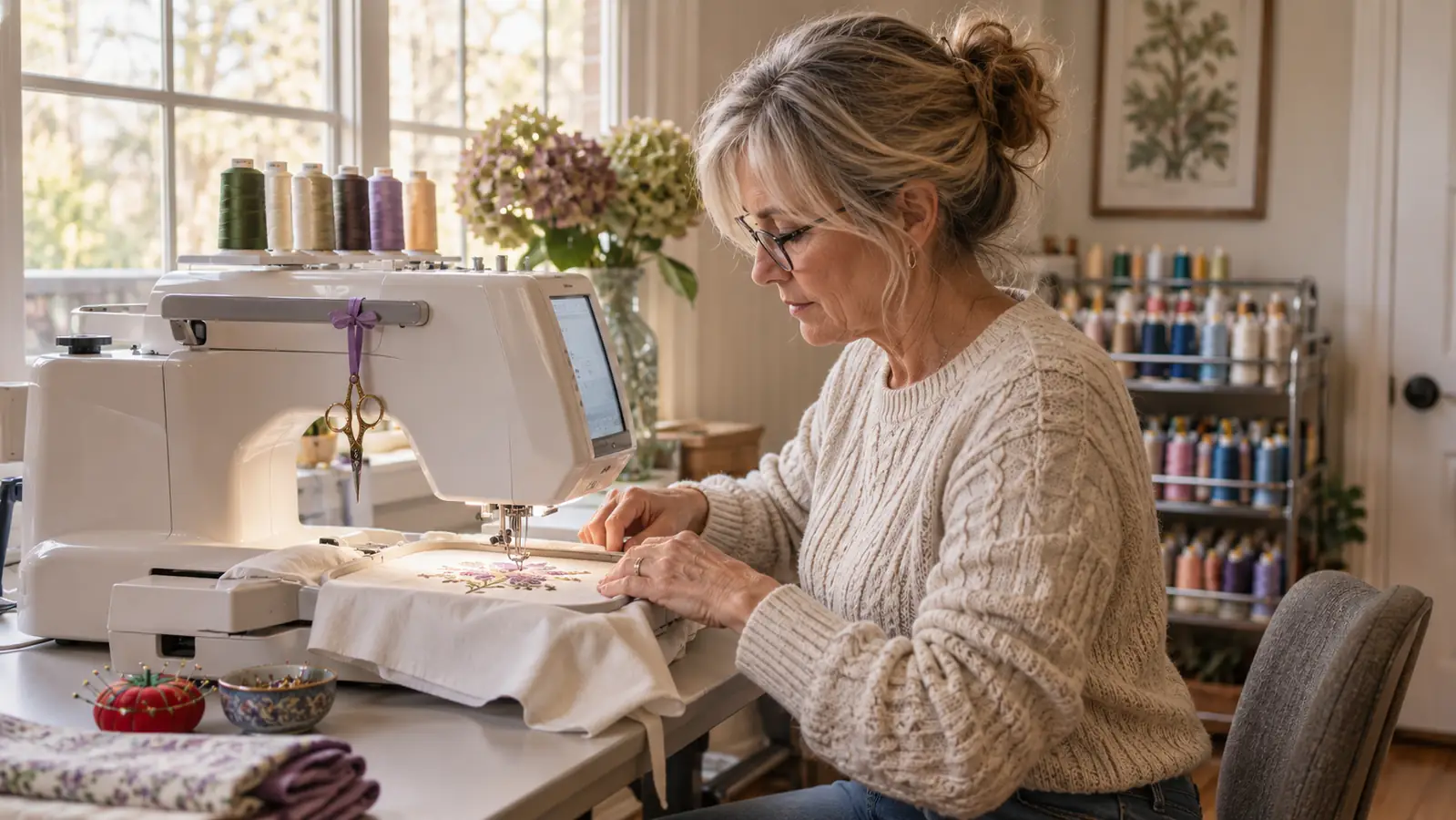
Nobody warns you about the jump stitches. You buy the machine, you take the two week practice run on scrap towels, and then you sit down with your first real design and discover that the embroidery arm stops between every letter and leaves a thread crossing the gap. Multiply that by a name with nine letters and you have a small nest of loose thread to deal with before the towel is allowed to leave the table. For my first month I dealt with it using kitchen scissors. Not a spare pair. The good ones, from the drawer beside the stove, carried upstairs and set down somewhere and found again three days later under a stack of tear away stabilizer.
In January 2024 I bought a pair of SINGER ProSeries 5 inch thread snips and tied them to the machine with a short length of ribbon. That was nearly three years ago. They have not come off the ribbon since. The kitchen scissors went back to the kitchen, where they have stayed, and I have not once stood at my folding table patting my own pockets looking for something to cut a thread with. That is the entire case for these, and it is a better case than any list of features I could give you.
The Quick Verdict
Nearly three years hanging by the machine. They cut jump stitches and thread tails cleanly, they sit light in the hand, and the only thing I would change is a spring that was stiff for the first week.
Amazon Check Today's Price →The pair that ended my kitchen scissors habit
Fine tips that slide under a jump stitch without snagging the towel underneath, a spring that opens the blades for you, and stainless steel that has held its edge through nearly three years of daily trimming.
Amazon Check today's price on Amazon →How I've Used It
I sew in the spare bedroom upstairs. One six foot folding table against the window, a rolling cart for thread, a corner shelf for blanks, one outlet strip along the wall. The machine sits with the embroidery arm on almost all the time, and I take it off maybe once a month to hem something. The snips hang on a ribbon tied near the handle, which means my hand goes to them without my eyes leaving the hoop. That is the whole point of the thing. When you are trimming a jump stitch between the first and second letter of a monogram, you are not looking at your hand. You are looking at the needle plate or at the design on the screen, and you need the tool to be exactly where your fingers already expect it to be.
My work is not complicated. Monograms and names on hand towels and bath towels, fleece baby blankets, canvas tote bags, cloth napkins. Nothing with a cap frame, nothing in leather, nothing sold online. A few things for friends and church members who text me a name and a date, and one booth at St. Peter's in December. Every one of those items comes off the machine with jump stitches somewhere, and every one of them gets a pass with the snips before it joins the finished pile. I would guess I pick the snips up thirty or forty times in a session. I do not count. I just know the motion, and I know that on the days I forget to put them back on the ribbon I feel it immediately, because the next jump stitch sits there waiting while I go looking.
Two things I want to be clear about, because reviews of small tools tend to overstate what a small tool can do. First, these did not replace my curved embroidery scissors. I keep a small unbranded curved pair in the table drawer for trimming close on the back of a blanket, where the fabric has to be held flat and the cut has to be tight against the stitch. Second, these are not shears and I do not use them that way. They cut thread. If someone picks them up intending to cut a hem or a length of stabilizer, they will not do it well and they should not.
What the Snips Actually Do at the Machine
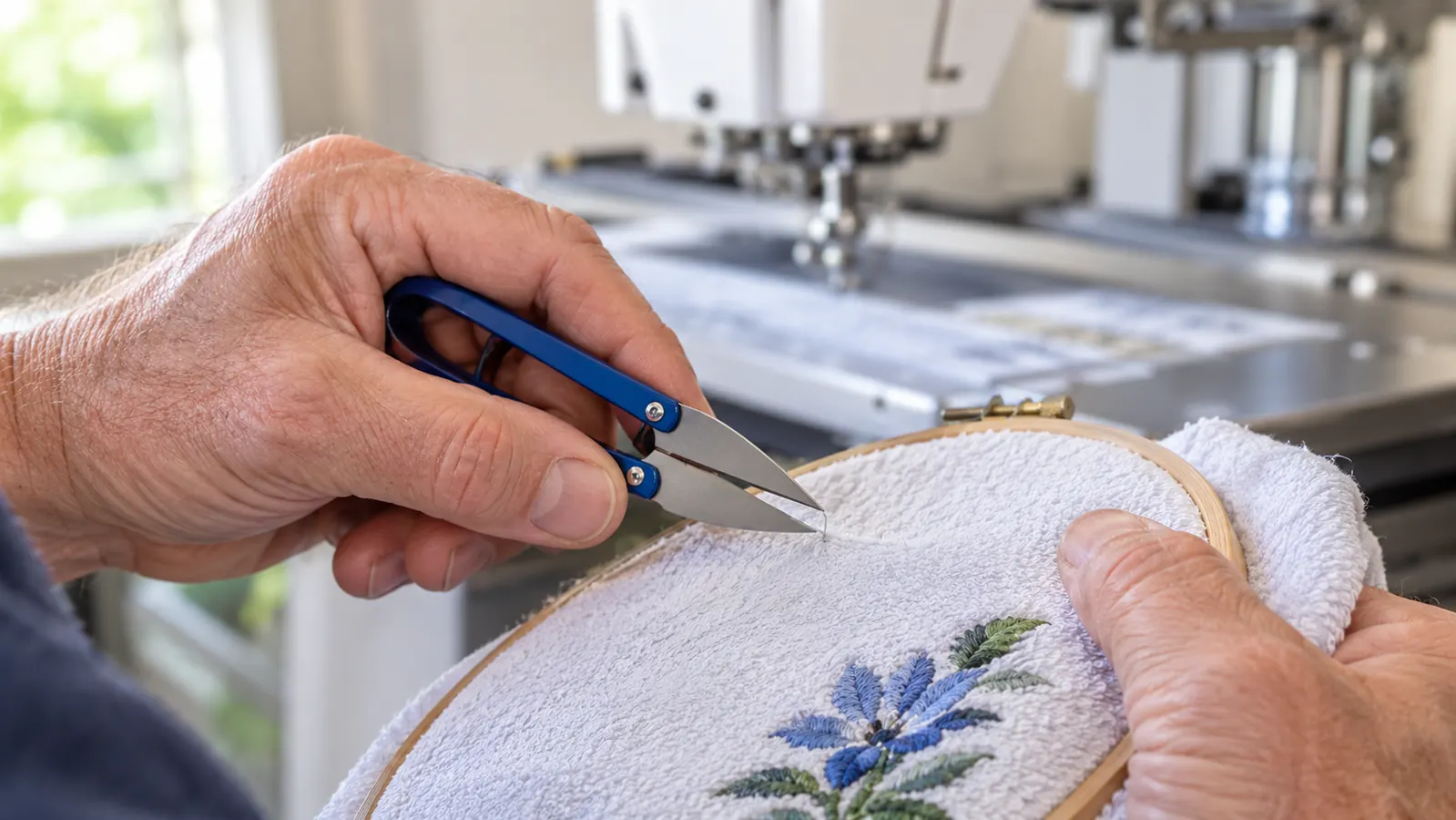
The SINGER listing calls them fine tip blades with a straight blade edge, and that description is honest. The tips are narrow enough to slide under a jump stitch on a towel without catching the terry cloth underneath, which is the part that matters most to me. With the kitchen scissors I was forever nicking a loop of the towel and pulling a small snag, and then I would spend the rest of the evening deciding whether to try to work the snag back in. That stopped happening. The cut is clean rather than a crush, so the thread end does not fray into a fuzzy little brush that then gets caught up in the next pass of stitching.
The spring returns the blades on its own, so it is a genuine one handed tool. My right hand holds the hoop steady and my left hand does the snipping, and I never have to open the blades with my fingers between cuts. Do that forty times in an evening and an automatic return stops being a nicety and becomes the difference between a rhythm and a chore. The stainless blades have stayed sharp through nearly three years of thread, which is not a demanding job for steel, but they have also been dropped on a hardwood floor twice and there is no burr and no wobble in them afterward. I checked both times, expecting to find one.
Ambidextrous is a claim in the listing and I can only half vouch for it. I am right handed. My friend Marjorie from church is left handed, and when she was over in the spring she picked the snips up off the ribbon and trimmed a tail with them and did not complain about the handle shape. That is the sum of my evidence on the subject, offered for what it is worth. The grip itself is rubber over the body of the tool, and the finish is a matte surface rather than something polished and slick. It stays comfortable in a warm room and it does not get slippery the way a bare metal handle does after twenty minutes of handling.
The Spring, the Grip, and My Hands
The whole tool weighs 1.44 ounces. That is light enough that my hand does not tire holding it between cuts, which sounds like a small thing until you have used a heavier pair for an hour and felt your thumb at the end of it. The 5 inch length puts the tips close to my fingers, so I have good control right at the point, and the fine tip does the precision work rather than the whole tool having to be maneuvered into place. For trimming at a machine, with the hoop in one hand and the work lit by a window, that short working distance is the reason it feels natural instead of awkward.
The one complaint I have, and it is a real one, is the spring. For the first week it was stiff enough that my hand ached after a long session. It was not a defect, it was new, and it has since loosened into a comfortable tension and stayed there for the better part of three years. But if your hands are arthritic or your grip is not what it was, know that a fresh pair out of the package takes some breaking in, and plan your first few sessions around that. I would not want someone to buy these, run them for three hours on a dense design, and conclude the tool is painful to use. It is not painful. It is just stiff at the start, and then it is fine, and then you stop thinking about it at all.
They have been dropped on a hardwood floor twice in nearly three years, and there is still no burr and no wobble in the blades. I checked both times, expecting to find one.
Where They Fall Short
Three honest limits. The first is the stiff spring, which I have already covered and will not pretend is imaginary. The second is that these are thread snips and nothing more. They will not cut a clean straight line through stabilizer, they will not cut fabric to size, and they will not open a seam. I keep a small pair of straight scissors on the shelf for that work, and I am never tempted to reach for the SINGER snips instead because I know exactly how it would go. A short blade with a spring and a fine point is a specialist, and expecting it to be a general purpose cutter is how people end up disappointed in a tool that was doing its own job perfectly well.
The third is the temptation of a cheaper pair. These are not the least expensive snips hanging in the sewing aisle, and I have watched people talk themselves into a bargain version instead. What you tend to get with the cheap ones, in my experience of inexpensive craft tools generally, is a spring that gives out, a pivot that works loose, or tips that go dull and start crushing thread rather than cutting it. I have not had to replace this pair, and I have not had to think about it, which is the highest compliment I can pay a small tool. That reliability is worth more to me than the difference at the register.
I should also say that a review written after eight months would have been a different review. At eight months I was still slightly aware of the tool every time I picked it up. Somewhere in the second year it stopped being a purchase I was evaluating and became part of the room, like the lamp or the outlet strip. That is not a very exciting thing to read in a review, but it is the thing you actually want from a pair of snips. You want to stop noticing them.
What I Still Keep in the Drawer
The curved embroidery scissors, as I said, for close work on the back of a fleece blanket. And a small straight pair for cutting tear away to size, because a spring snip is the wrong instrument for a straight line through a sheet of stabilizer. When I started in the fall of 2023 I used the kitchen scissors for all of it, and now I have three tools with three jobs, which is the honest arc of the thing. The snips are the ones picked up most often by a wide margin, and the ones I would replace first if they went missing off that ribbon.
I have not owned the magnetic snips or the fancier spring loaded thread cutters that some people swear by, so I cannot rank them against these. What I can tell you is that a bargain pair I tried once in a friend's sewing room felt like a different category of object entirely, and that this pair has held its tension and its edge through nearly three years of daily use. If you are deciding between this and a cheaper version, my advice is to buy the one that feels solid in your hand and expect to still be using it. That is a dull recommendation, but it is the true one.
What I Liked
- Fine tips slide under a jump stitch without snagging the terry cloth underneath
- The spring return makes it a genuine one handed tool at the machine
- Light at 1.44 ounces, comfortable through a long evening of trimming
- Stainless blades have held their edge and their alignment through nearly three years
- Ambidextrous enough that my left handed friend used them without complaint
Where It Falls Short
- The spring is stiff for the first week or so of use
- Thread only, they will not cut stabilizer or fabric cleanly
- Not the least expensive option in the sewing aisle
Who This Is For
If you have an embroidery machine set up in a spare room and you are trimming jump stitches by hand, this is the tool that takes the friction out of that job. It is also a sensible first pair for someone who has just bought their first machine and is still borrowing from the kitchen drawer. It suits hands that want something light and a grip that wants rubber rather than bare metal. My machine is a Brother SE1900 with a five by seven inch field, bought in October 2023, and the SINGER snips arrived three months later. I wish they had arrived in the same week, and I would tell anyone starting out to buy them alongside the stabilizer rather than waiting to see whether they need them. You will need them. The very first design will tell you so.
Who Should Skip It
Skip it if what you mainly need is to cut fabric, stabilizer or seams, because it is not that tool and it will frustrate you. Skip it if you want the cheapest option available and do not mind replacing it in a year. Skip it if your hands are arthritic and you want something with a soft return straight out of the package, because this one needs breaking in. And skip it if you already own a pair of spring snips you like, because there is no reason to own two of the same thing. A bargain has its place. This is simply not the place I would choose to chase one.
If your jump stitches are still being cut with the kitchen scissors
A ribbon, a hook, and a tool that lives where your hand already goes. That is the upgrade. Everything else about these snips is ordinary and reliable, which is what you want from something you pick up forty times an evening.
Amazon See the current price on Amazon →