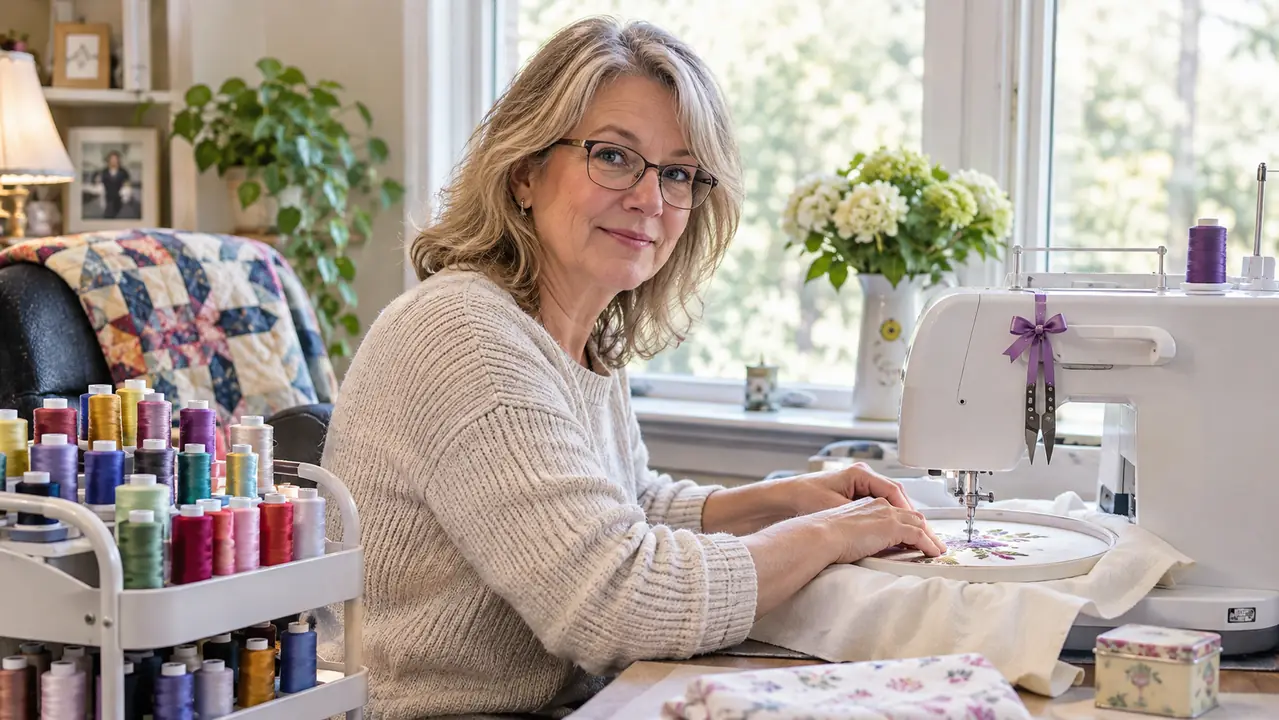
Two small cutting tools sit within arm's reach of my embroidery machine, and I use both on most days. If you are buying only one, buy the SINGER ProSeries thread snips. They hang from a short ribbon beside the machine handle, they open with a squeeze, and they clear a jump stitch faster than I can think about it. That is the job that repeats itself through every monogram I stitch. The curved embroidery scissors in my table drawer are better at a different job, and I will get to that in a minute.
Here is the short answer. For work at the needle, while a design is running or just after it stops, the SINGER snips win and it is not close. For work on finished goods, where a tail has to come off without lifting the nap of a fleece blanket, a small pair of curved embroidery scissors wins. I keep both. If you truly want one tool, pick it by where you stand when you cut, not by which one looks nicer in the catalog.
| SINGER Thread Snips | Curved Embroidery Scissors | |
|---|---|---|
| Best job | Jump stitches and thread tails at the machine, one squeeze per cut | Trimming close on finished work where the fabric must not lift |
| Reach while a design is stitching | Hangs on a ribbon tied near the machine handle, always in place | Kept in the table drawer, so it is a two step reach |
| Clearing a run of tails | Spring action, one hand, no finger loops to find | Finger loops and no spring, so each cut is open, close, open |
| Getting under a tail lying flat | Fine tips, but the blades meet straight and the tail has to be pinched and lifted | Curved blades lay flat and slide under the tail |
| Where the point sits against the goods | Points face the work straight on | The curve lifts the point up and away from the fabric |
| Left handed cutting | Ambidextrous, works the same in either hand out of the package | Most pairs are molded for a right hand, so a left handed pair is a separate purchase |
| Where it lives | Five inches, 1.44 ounces, hangs out of the way | Small enough to keep point down in a drawer |
Where the SINGER Snips Win
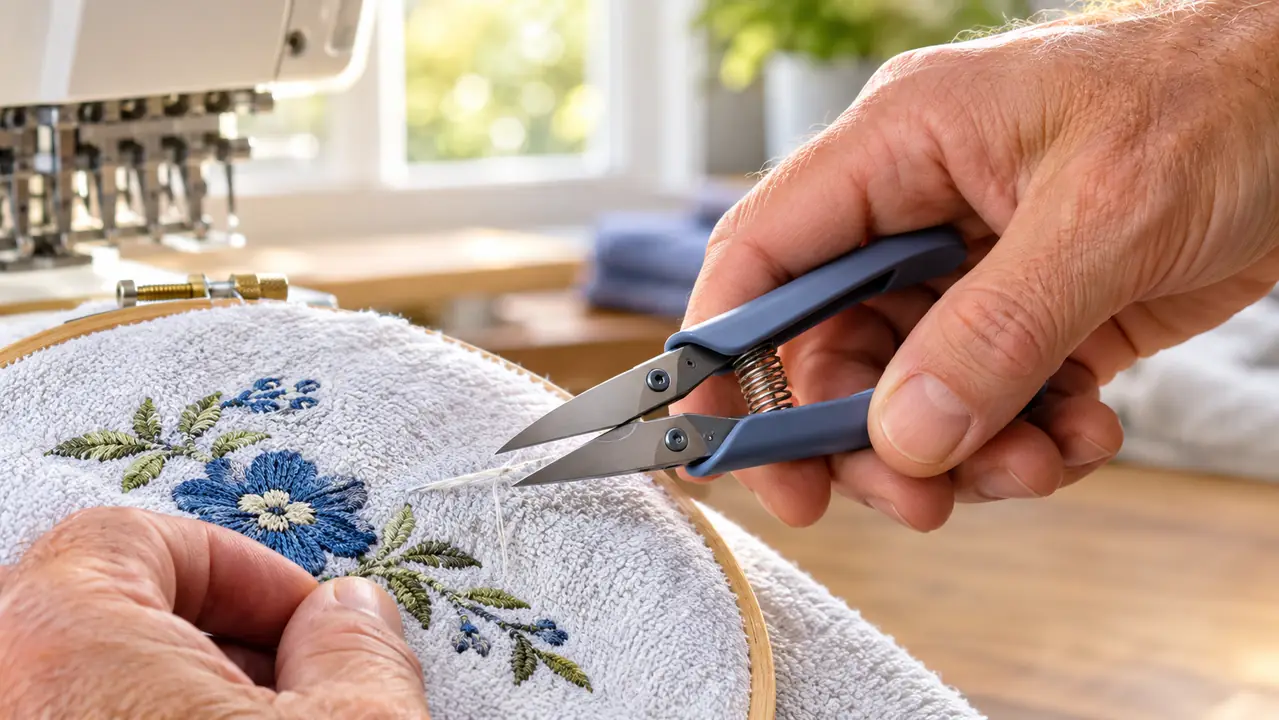
The snips do one thing and they do it fast. No finger loops. You squeeze, the blades close, you let go, the spring opens them again. My right hand can hold a hoop steady while my left hand cuts, or the other way around, because the tool is ambidextrous and does not care which hand picks it up. When a jump stitch runs from the last letter of a name to the edge of a towel, I do not have to set anything down or look away from the needle.
Here is a concrete one. A bath towel with the name Harper in navy, six letters, stitched in one of the built-in fonts on the SE1900. The machine carries thread from the H to the a and from the r to the p, and every one of those carries is a tail I have to cut. On a name like that I count seven or eight tails before the design is done, plus two more at the end where the thread jumps out to the edge of the field. With the snips I clear them without lifting my eyes off the needle. With anything else I would be hunting for loops with my fingers while the hoop sits there waiting on me.
The measurements matter more than they sound like they would. It is a five inch tool at 1.44 ounces, so a ribbon looped around it does not drag the ribbon off the hook, and it does not swing into the hoop when I lean across the table. Stainless blades, fine tips, a straight edge, a rubber grip and a matte finish. The rubber grip is the part I notice in August, when the room upstairs is warm and my hands are not at their best.
One more thing in its favor, and it is not a small one. The spring holds the tool open, so picking it up and putting it to work is a single motion. That sounds like nothing until you have made that same cut over and over through a long afternoon and your wrist starts giving you opinions.
Where Curved Embroidery Scissors Win
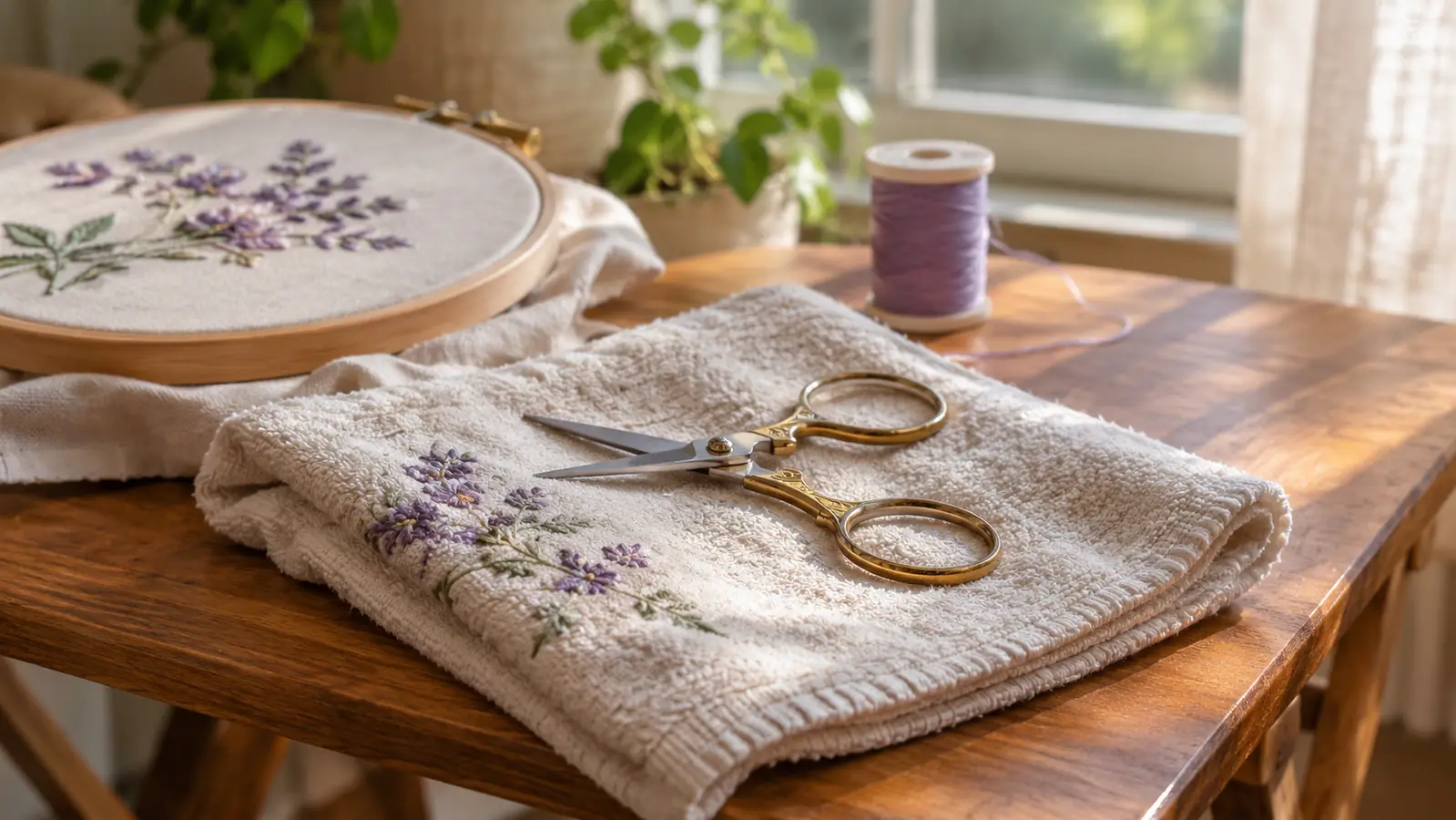
A curved embroidery scissors is a slower tool and a more careful one. The blades curve, so the point rides up and away from the fabric while the cutting edge stays flat against it. That is the difference on the back of a fleece baby blanket. The snips have fine tips, but the blades meet straight, and to cut a tail lying flat I have to pinch the tail and lift it first. Lifting is the one thing I do not want to do to fleece.
The fleece blanket I made for my granddaughter Lily is the piece that taught me this. Fleece has a nap, and a straight blade has to get under the tail in order to cut it, which means the tip goes down into the fleece and comes back up with a little bloom of fuzz attached to it. Do that four or five times across the back of a blanket and the back stops looking new. The curved blades slide along the surface, catch the thread, and never dig in. That blanket goes through the wash with the rest of the house linens and the back still looks like the front.
I also use the curved pair on hand towels before they go into a gift bag. A finished towel gets a last look on the table by the window in the morning light, and any tail that survived the machine gets trimmed then. Curved scissors let me slide the point under the tail with the towel lying flat on the table. Slow, deliberate, one tail at a time. That is the opposite of what I want at the needle and exactly what I want at the finishing table.
Mine are a plain pair with no name on them, kept in the table drawer with the point down. They did not get replaced by the snips and I do not expect they ever will. Different job, different tool, and I am done pretending one can cover both.
The tool I want in my hand while the machine is still running
Five inches, stainless blades, fine tips, a spring that reopens the blades for you, and a rubber grip that works the same in either hand. Mine hangs from a ribbon tied near the machine handle and has not left that spot since January 2024.
Amazon Check Today's Price on Amazon →How I Ended Up With Both
I bought the Brother SE1900 in October 2023, my first embroidery machine of any kind. My mother's old sewing machine had been given away decades before, so I started from nothing and spent about two weeks on scrap towels before I trusted myself with a gift. The machine came with one 5 by 7 hoop. Everything else in that room, I bought because something was annoying me.
What was annoying me in December 2023 was thread. The machine does not cut jump stitches, so every design leaves tails, and I was walking downstairs to the kitchen for the good scissors and back up again. After a month of that I ordered the SINGER snips in January 2024. I tied a short ribbon around the handle of them and looped the ribbon near the machine. They have not been put away since.
The kitchen scissors were the first thing I tried, and they failed for a reason I did not expect. They were long, so the handles sat well above the hoop and the blades came down at an angle, and to get the tips anywhere near a tail I had to tilt the hoop toward me. Tilting a hooped towel means the fabric shifts inside the hoop, and shifted fabric means a monogram that sits crooked on the goods. I did that twice on scrap before I understood it was not a technique problem I could practice my way out of. It was the wrong tool for the reach.
The curved scissors came first, actually. They were in a drawer from my garment sewing days as a teenager, back when I had different hands and a great deal more time. They are not fancy and there is no name on them anywhere. For a while I assumed the snips would retire them. They did not. One tool is for the machine and one is for the finished piece, and that has held ever since.
How Each One Lives in the Room
The snips have one home and it never changes: a short ribbon tied around them and looped near the handle of the machine. When I lift the embroidery arm off to hem something, the snips stay put. When I slide the arm back on, they are already there. The ribbon is not decoration. A tool that lives in a drawer is a tool I will not use, and I proved that to myself in December 2023 while walking to the kitchen.
The ribbon itself is nothing special, a narrow strip of grosgrain left over from a tote bag project, maybe eight inches long. I tied a loop around the handle of the snips and tied the other end around the upright near the machine handle, high enough that the snips hang clear of the table and low enough that my hand finds them without my having to look. The first week I had them on a hook on the wall behind the table, and I kept reaching to the wrong place out of habit. The ribbon fixed that in about one afternoon.
The curved scissors live in the top drawer of the folding table, point down, next to the seam ripper and a marking pencil. That drawer is for finishing work, so the scissors being there is a signal to me. The stitching is done, now make it presentable. Two homes, two jobs. It sounds fussy written down. In practice it is the least fussy part of the whole hobby.
What Neither Tool Does
Neither one trims jump stitches for you. The SE1900 has no automatic thread cutter and does no jump stitch trimming, so the cutting is mine, by hand, one tail at a time. That is the entire reason a snips lives on a ribbon instead of in a drawer. If a tool is not within reach while the needle is moving, I will skip the tail and regret it later when I am finishing.
Neither one is for cutting fabric either. Fine tips are for thread, and using them on a towel hem or on a strip of tear away stabilizer is how you dull a good edge. Tear away gets torn. Fabric gets the big shears. And neither tool replaces a seam ripper, which is its own separate thing and one I hope not to need very often.
A Note on What I Have Not Tried
I have owned exactly one pair of spring thread snips, this SINGER pair, so I cannot tell you how its spring tension compares with another brand. I can tell you the spring felt stiff for the first week and then it stopped being something I noticed. I have never used a snips with a curved blade or with a locking latch, so I have no opinion to offer on whether those help or get in the way.
Same with the curved scissors. Mine have no name on them and they came out of a drawer, so I cannot recommend a brand. What I can tell you is that the shape does the work. If you go shopping for a pair, look for a curve you can lay flat against fabric and points fine enough to slide under a thread, and set down anything that feels loose at the pivot.
Who Should Buy Which
Buy the SINGER thread snips if you stitch on a machine and you are tired of walking across the room for scissors. That is the reader I have in mind. It suits someone working at a folding table with a hoop in front of them who wants the tool to come to their hand without a thought. The ambidextrous grip means it does not matter which hand is free. The spring means it is ready before you are.
Buy curved embroidery scissors instead if you almost never sit at a machine and your work is all finishing by hand: hems, small handwork, the last tails on a gift before it goes in the bag. Or do what I did and start with the snips, because the machine work comes before the finishing work in this house, then add a small curved pair the first time a fleece blanket teaches you why you want one. You do not need both on day one. I would be surprised if you got through the first month without wanting both.
If the tails are piling up faster than you can chase them, start here
The SINGER ProSeries snips are what I bought to stop walking downstairs for the kitchen scissors, and they are still tied to the machine two years on. Five inches, stainless, fine tips, spring action, either hand.
Amazon Check Today's Price on Amazon →