I bought the SINGER ProSeries 5 inch thread snips in January 2024 because I had spent a month reaching for kitchen scissors every time my embroidery machine stopped with a thread tail hanging off the needle. That is not a dramatic origin story. It is the reason the snips live on a short ribbon tied near the machine handle now, and the kitchen scissors are back in the kitchen drawer where they belong.
Here is what nobody tells you about a small pair of thread snips: they are not a replacement for embroidery scissors, and they are not a tool you buy once and forget. They have one job at my table, trimming jump stitches and thread tails at the needle, and they do that job well enough that I notice when they are not within reach. They also have a first-week stiffness that made me wonder if I had wasted my money. I had not, but I understand why someone else might. The SINGER snips are a good tool with a narrow job, and the trouble starts when you ask them to do a different one.
The Quick Verdict
A light, fine-tipped pair of snips that earns its place tied to the machine. Buy it for jump stitches, not for close trimming on the back of a blanket.
Amazon Check Today's Price →The tool that ends the reach across the table
If your machine leaves jump stitches and thread tails for you to trim, the SINGER ProSeries snips are the pair I would keep at the needle. They are small, light, and fine enough to get under a thread without dragging the fabric.
Amazon Check Today's Price on Amazon →How I've Used It
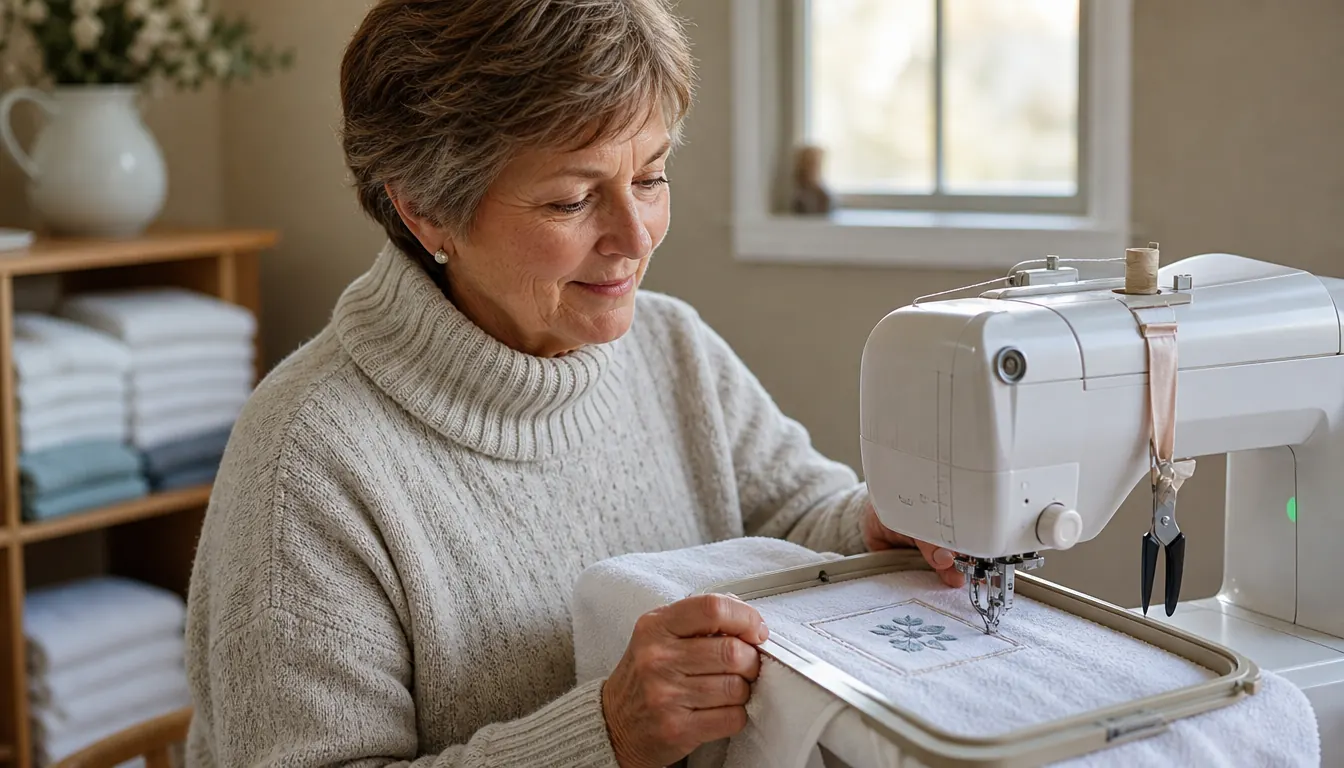
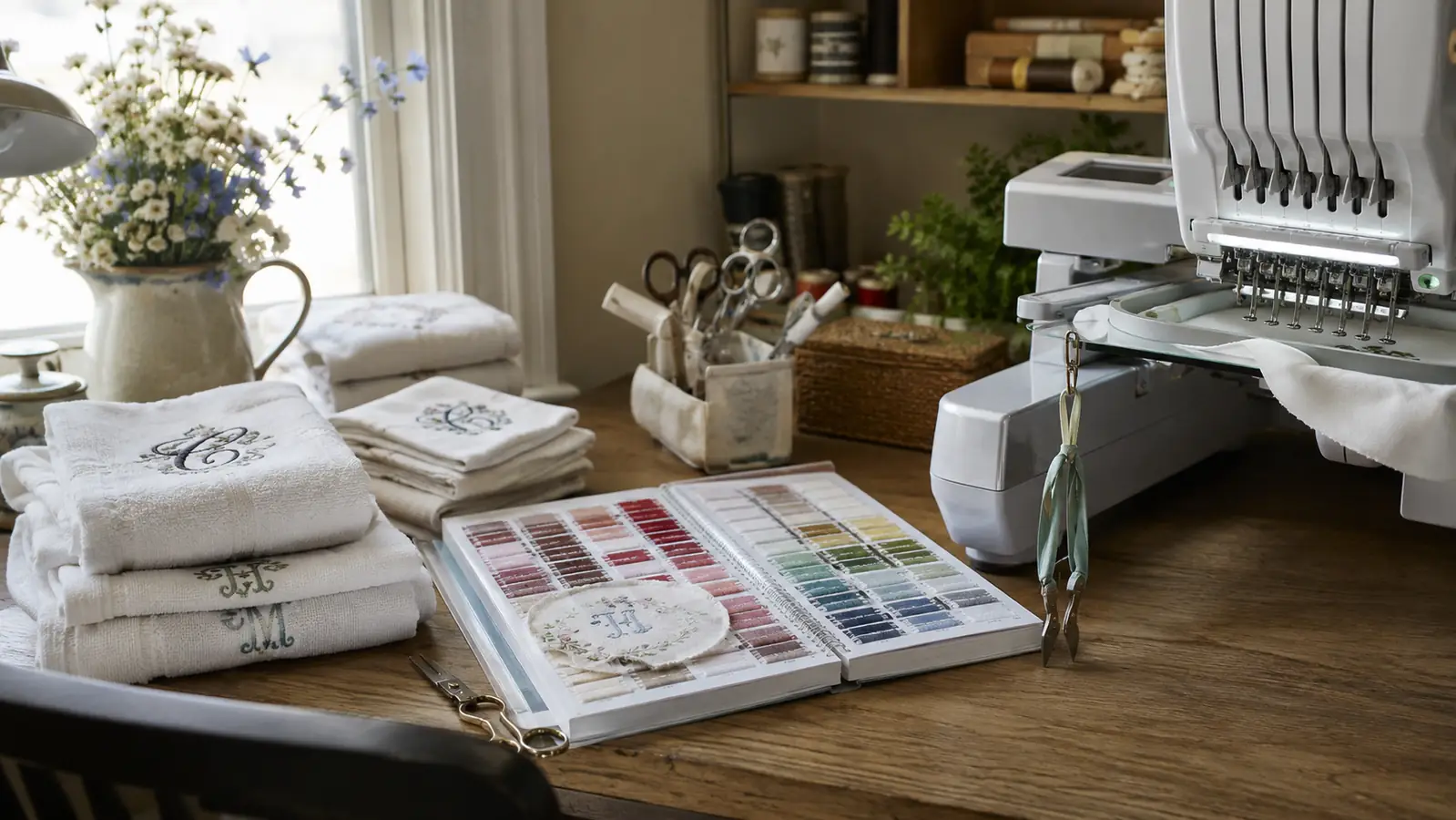
My setup is a Brother SE1900 on a six foot folding table in the spare bedroom upstairs. The morning light is good, which matters more for my patience than for the machine. I stitch monograms and names on hand towels, bath towels, fleece baby blankets, canvas totes and cloth napkins. Almost every project leaves jump stitches, the little traveled threads between letters, and the machine does not trim them for me. I trim them by hand. The SINGER snips are what I reach for.
The snips are 5 inches long and weigh 1.44 ounces, according to the listing. That weight is the reason I can hold them for a whole morning without my hand cramping. The handle is rubberized, the blades are stainless steel with a straight edge and fine tips, and the listing says they are ambidextrous. I am right handed, so I cannot speak to the left handed experience from the inside, but my friend Marjorie used them for ten minutes at the craft fair and did not complain. Take that for what it is worth.
Before January 2024 I used kitchen scissors for thread tails. They worked, in the way a butter knife works as a screwdriver. They were too long to get close to the needle without my hand blocking the light, and they crushed the thread instead of cutting it clean. The snips are small enough to keep my hand out of the way. The fine tips let me get under a jump stitch without tugging the fabric. That is the whole claim, and it is enough.
I keep them on a short ribbon tied to the machine handle area. I did not plan that. I got tired of setting them down and losing them under a folded towel. The ribbon keeps them within reach without taking up table space, and I can find them by feel while I am still looking at the needle. If you buy a pair, do yourself a favor and tie them to something. A five inch tool can disappear in a sewing room.
I also use them when I change thread. I pull the old spool, snip the tail at the needle, and start the next color without hunting for scissors. That is not the job I bought them for, but it is the job they ended up doing several times a day. A tool that saves you a turn and a reach is a tool that stays on the table.
What Nobody Tells You About the First Month
The first week, the action felt stiff. I have read enough reviews to know I am not the only one who noticed. It loosened up after a few days of steady use, and now it feels ordinary in the best way. I do not think about it. I squeeze, the thread parts, I move on. If you have arthritis in your hands, borrow a pair before you buy. A stiff action is a small thing until you are squeezing it two hundred times before lunch.
I also had to learn not to cut too close to the fabric. The fine tips are sharp, which is the point, but sharp tips and a nervous hand are a bad pair. On a hand towel, a nick near the monogram is not a repair, it is a remade gift. I keep one pair of small curved embroidery scissors in the table drawer for trimming close on the back of a blanket. The SINGER snips did not replace those. They replaced the kitchen scissors.
After the first month, I stopped thinking about the stiffness. That is the honest timeline. It did not loosen up in an hour, and it did not stay stiff forever. It became a tool I use without a second thought. If you need a pair that feels broken in on day one, this may not be the pair for you. If you can give it a week, it will settle in.
The snips did not replace my curved embroidery scissors. They replaced the kitchen scissors I had been borrowing for a month.
What They Are Not
These are not embroidery scissors. The blades are straight and the tips are fine, but the shape is made for snipping at the machine, not for sliding under a dense stitch-out to trim a jump on a finished towel. I tried that once. I could do it, but I did not enjoy it. My curved scissors are better for close work on the back of a blanket, and I would not want to be without them.
They are also not a thread cutter in the machine. The SE1900 does not have an automatic thread cutter, and no pair of hand snips changes that. I still stop the machine, lift the presser foot, and trim. The snips make that pause shorter. They do not remove it. If you are looking for a tool that lets you walk away from the machine while it finishes a design, this is not that tool.
And they are not fabric scissors. I would not use them to cut stabilizer, trim a seam allowance or cut a piece of fleece. The blades are meant for thread, and they do that well. I keep a separate pair of fabric scissors in the drawer for the other jobs. A small tool with one clear job is easier to trust than a small tool asked to do everything.
Where the Fine Tips Earn Their Keep
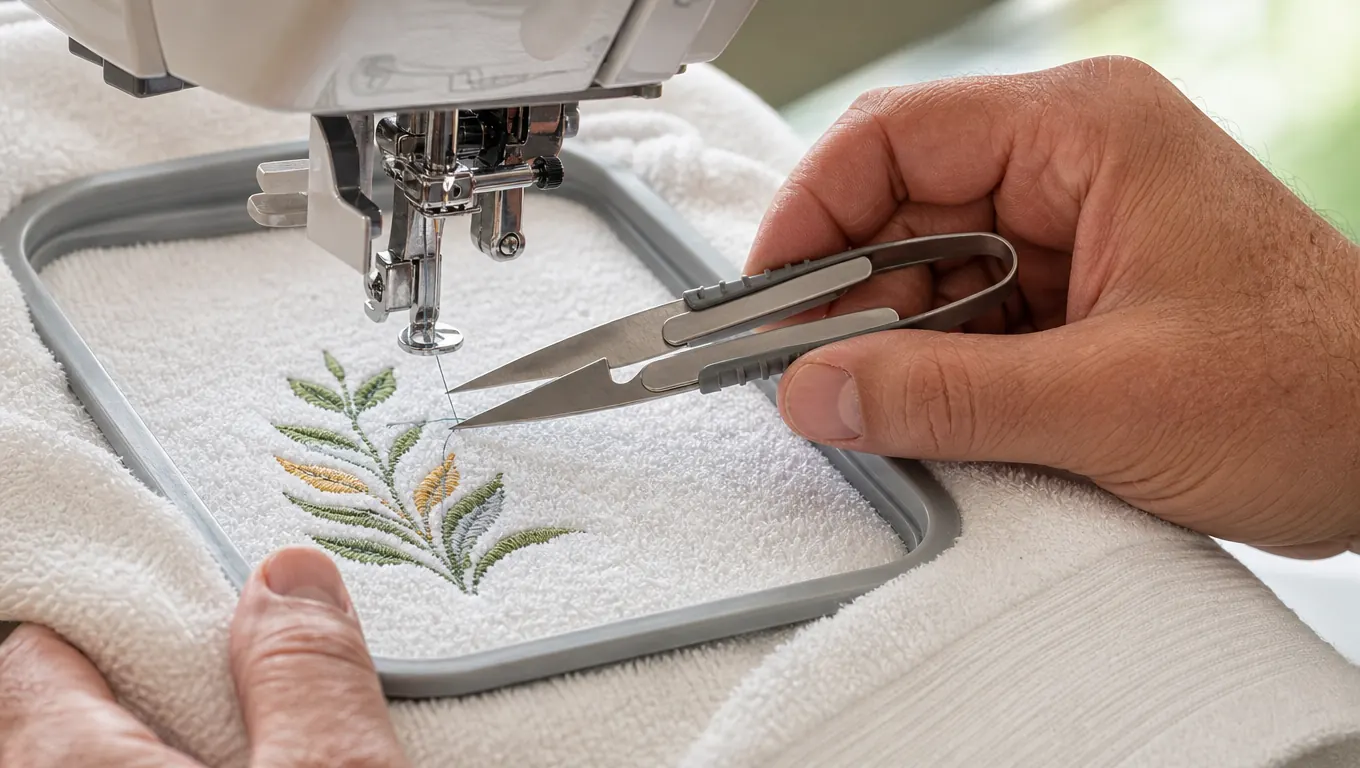
A jump stitch between two letters on a hand towel is usually a short traveled thread on the top. If I leave it, the back of the towel looks messy and the front has a faint line. If I pull it, I distort the fabric. The fine tips let me slide under the thread and cut it without lifting the towel off the hoop. That is the everyday win. It is not a dramatic win, but it is the difference between a towel I am willing to give as a gift and one I keep for the kitchen.
The same goes for thread tails at the start of a design. The machine stops, the needle is up, and there is a tail hanging off the first stitch. I snip it close and keep going. I do not have to turn the hoop or set down the snips. They hang on the ribbon beside the machine, so my hand goes to them without looking. That sounds like a small thing. It is a small thing. It is also the reason I use them every time I sit down.
The 5 inch length is short enough to control and long enough to keep my fingers away from the needle. I have not cut myself. I am careful, but I am also a woman who once cut a hole in a bath towel with kitchen scissors because I was rushing. The snips are easier to aim. The straight blade edge helps with that. I can see exactly where the tips are, even when my reading glasses are pushed up on my head.
On a thick bath towel, the fine tips still get under a jump stitch because the towel is hooped firm and the thread sits on top. If the towel is soft and floppy, I have to be more careful. That is not the snips' fault. It is the nature of a thick towel. I have learned to hoop it snug and trim before I take it off. The snips reward that habit.
I also use them on the back of a finished tote bag when a thread tail has worked its way loose. I can pinch the thread with the tips and cut it without opening the bag all the way. That is not a job I would trust to kitchen scissors. It is also not a job I would trust to a dull pair of snips. The fine tips are the whole reason it works.
The Annoyances I Actually Have
The only real annoyance is the first-week stiffness. I do not have another complaint about the tool itself. It has not rusted, the blades have not dulled enough for me to notice, and the rubberized handle has not slipped in my hand. I have used it most days since January 2024. That is not a lifetime test, but it is long enough for a first impression to wear off.
The other limitation is not a defect. It is the job. The snips are made for thread, not for fabric. I would not use them to cut a piece of stabilizer or trim a seam allowance. I have a pair of fabric scissors for that, and I keep them in the drawer. If you buy the SINGER snips expecting one small tool to do every cutting job at your table, you will be disappointed. If you buy them for jump stitches and tails, you will not be.
I have not lost them, chipped the tips or had the ribbon knot fail. That is a low bar, I know. But small tools at a sewing table take a beating. Mine has been dropped on the floor twice and has lived to tell the tale. I would not test that on purpose. I am just saying the tool is sturdier than its 1.44 ounces suggests.
The listing shows 4.5 stars from more than 7,200 ratings. That tracks with my experience. Most people who buy a pair of thread snips are not looking for a hobby horse. They want a small tool that cuts thread without making their hand ache. The snips do that. The reviews that complain about stiffness are also telling the truth. The reviews that call them flimsy are, I think, expecting scissors. These are snips. They are light on purpose.
What I Liked
- Fine tips get under jump stitches without dragging the fabric
- 5 inches and 1.44 ounces, light enough to hold through a morning of stitching
- Rubberized handle and ambidextrous design
- Stainless steel blades with a straight edge
- Easy to keep on a ribbon at the machine, so it is always within reach
Where It Falls Short
- The action is stiff for the first week
- Not a replacement for curved embroidery scissors
- Will not cut stabilizer or fabric the way fabric scissors do
Who This Is For
This is for the home embroiderer who trims jump stitches by hand and is tired of reaching across the table for whatever scissors are nearest. It is for the person who stitches towels, blankets, totes or napkins and wants a small pair of snips that lives at the machine. It is also for the person who has a machine without an automatic thread cutter and has accepted that trimming is part of the process. If you are that person, the SINGER ProSeries snips are a sensible purchase.
They are also a fair choice for someone who sews garments and keeps a pair at the serger or the machine. The fine tips are useful for thread tails in tight places. I would not buy them as a first pair of scissors for a beginner. A beginner needs fabric scissors and maybe a seam ripper before a pair of snips. But once the trimming becomes routine, the snips earn their place.
Who Should Skip It
Skip it if you want one pair of scissors to do everything. Skip it if you need a tool for trimming close on the back of a finished blanket, because curved embroidery scissors are better for that. Skip it if hand strength is a concern and you cannot try a pair first, because the first week is stiff. And skip it if you are looking for a machine attachment or an automatic thread cutter. This is a hand tool. It does not automate anything.
If you mostly sew garments and rarely deal with jump stitches, you may not need a dedicated pair. Your regular thread snips or small scissors will do. The SINGER snips are not magic. They are a small, well-shaped tool for a specific pause at the machine. If you do not have that pause, save your money for stabilizer or thread.
A small tool that earns its ribbon at the machine
If your machine leaves jump stitches and tails for you to trim, the SINGER ProSeries snips are the pair I would tie to the handle area and use until the stiffness works itself out. They are not the only cutting tool I own. They are the one I reach for most.
Amazon Check Today's Price on Amazon →